Click here for the Dwell On It, Second Life comic archives!

We have moved!


(pardon our dust)

Sunday, May 10, 2009

I surrender...

Okay. Yes. Thankyou everyone for mentioning it :)

I surrender, yield, and generally give in. Congratulations :)

Today, Dwell On It is now on Wordpress, on its own domain, partially thanks to the awesome folks at DreamHost.

Every post and comment should be there.

I did spend a couple hours rapidly learning style-sheets, PHP and wordpress getting everything installed, configured and migrated. I will probably tune-up the look a little over the next while.

If all has gone well, your RSS feeds will already be feeding from the new blog feed, thanks to a bit of technomagical wizardry. I hope. Sure, it bites a bit to lose the search-rankings and all of that, but you've all managed to convince me that this is the right way to go.

If you've come in late and you're looking at the blogspot.com site wondering where the posts are, you need to be looking here instead. With luck, though, you are already looking at the new site.

(and wouldn't you know that all the links would get screwed up while passing them around among people and tools? -- All fixed now)

Populous, the origin of

"We couldn't sell it to anyone" -- Bullfrog's famous 1989 game, Populous was a huge hit, but it was a serendipitous one. A tiny business making a game without a clear target idea, Bullfrog hit on success with a combination of luck and plain-old hard work.

"Our royalty cheques were due to be paid one quarter in arrears, and we didn’t expect to get any ... The next cheque was for a quarter of a million. I thought it was a mistake at the time. I actually called EA to tell them."

Edge Online has the fascinating tale of how this hit game came about.

Saturday, May 09, 2009

A public service announcement

For the record, I'm Tateru Nino. I'm a professional writer and I write about all sorts of stuff, including Second Life and Linden Lab.

Now, here's the important bit: No, I don't run Second Life. No, I don't run Linden Lab either. Nor do I work for them. No, I am not the right person to talk to insofar as demanding that I change a Second Life policy, or fixing a Second Life bug.

No, I can't unban your account. No, I can't ban someone else's account for you, even -- and I want to make this absolutely clear -- even if he touched your dolly.

Astonishingly, I also can't fix any billing issues you have or cancel your account or open a new one for you, or sell you an island ... so please stop sending me your names, addresses, credit-card information, and Second Life user names and passwords.

Seriously, people. Don't send me that stuff. Please stop sending me that stuff. The only thing I can do with that would be to steal your identity and run up your credit-card bill -- and I'm not going to do that. (Actually, come to think of it, that would be plenty of info to report your card as stolen, but I'm not going to do that either)

The people you want to talk to are called Linden Lab, and you can contact them via their support page (there's telephone numbers there too).

That this post even becomes necessary gives you some idea how far out of hand it has been.

Friday, May 08, 2009

Second Life data update

Good news:

Second Life total signups is back on the air. The feed lit up again on 4 May. The weekly signup chart will come back online as soon as there's enough data. The figure presently reads 15,348,641. Pre-purge that was 16,753,668. How many accounts were purged is unknown, but shouldn't be hard to estimate with some reasonable accuracy.

Not so good news:

Linden Lab is only providing updated concurrency data twice per hour. Once at 5 minutes past the hour, and again five minutes after that (ten minutes past the hour). Then nothing for another 45 minutes. That means the 30-minute deltas are pretty useless. There's not enough data to chew on.

Technology is awesome.

Anyway, right now you'll see a lot fewer red sections in the charts. There have been a few internal structural changes as well, but they likely won't affect chart viewers in any significant way (except to save you a little bandwidth).

Meet the editor

Yesterday, I got the chance to meet up AFK with my editor from The Metaverse Journal, Lowell Cremorne. Lowell was in town for a day for a conference. It was scary, fun, and awesome. There was also lasagne!

Thursday, May 07, 2009

Twitter for Dollhouse season 2

My partner and I have recently been watching Joss Whedon's Dollhouse.

Firstly, we can see why a lot of Whedon fans might be disappointed in it. It doesn't carry the same sort of 'flavour' as previous works. Buffy and Firefly had a fairly strong sense of adventure. Dollhouse doesn't have that.

But there's actually nothing really wrong with it. We started watching with no preconceptions as to genre or style, and we've so far been very impressed with the results. It's complex, dark, morally ambiguous, and the cast is doing a tremendous job.

It's got to be hard for Whedon. We think Dollhouse has an awesome flavour, but if it isn't the flavour you are expecting you can be disappointed. Roast beef and chocolate are both great flavours, but if you get roast beef when you're expecting chocolate, that's going to be somewhat offputting.

We, personally, are enjoying it hugely. That doesn't mean you will, or that you should. It doesn't mean that you're not being fair to the series. This sort of thing is hugely subjective and what you think about the show is no less valid than what I think about it.

If it's something you like, though, or that you want to see continue, there's a twitter campaign to encourage Fox to go with Season 2. Thanks to the charming Felicia Day for the heads-up.

Dollhouse. It's not Firefly, but that doesn't mean it can't be satisfying in its own way.

Impressions: Frenzoo

I've done many things in my time. No, I'm not ancient (it just seems that way). I've just packed a lot of things in in the time I've had. I've been to school, I've had jobs, and I've had hobbies. It's kept me pretty busy.

There's one hobby that I've never made enough time for: fashion design. Do you draw little sketches of ideas, and occasionally develop those into full-colour plates and flats? Make your own patterns? Sit down at an actual sewing machine and construct a garment? Peruse magazines, books, and Web-sites, and any other fashion-related material you can lay your hands on?

There's a new way to share and to indulge that passion, regardless of your skill level: Frenzoo!

Don't wander off quite yet, if you're a Second Life user, because there's a chunk of awesome coming.

doit-frenzoo001 Frenzoo is a fantastic place to meet like-minded people, girls and guys, who love fashion, whether they be spectators, shoppers, designers, or all of those at once. Located at http://www.frenzoo.com/, the site constitutes a virtual (by which I mean, it exists digitally) world of fashion, incorporating shopping, design tools, forums, clubs and fashion shows.

Still in beta, Frenzoo is already a fine establishment, and steaming along at speed:

The web site is easily useable and navigable, with a minimalist look and feel that is pleasant to the eye.

The design tools for clothing creation are already superlative. The tool interface is simple and intuitive, while allow quite sophisticated designs to be put together. As a user with a free account, I have not yet had access to the Advanced features of the design tools; access is currently restricted to VIPs and people on the Frenzoo team. Nonetheless, the quality of the available tools leads me to expect more of the same from currently unavailable tools.

Now that design tool would be absolutely amazing in Second Life. Seriously. Imagine being able to design clothing for an avatar without reaching for The GIMP or Photoshop. It's all kinds of clever, and it's the sort of thing that Second Life is clearly missing. It's accessible, live and immediate.

Frenzoo is only to be used by those persons 13 years and older; those persons under 18 must have the permission of their legal guardian. Thus, considering that the age of many users will lie between 13 and the low 20s, the users for the most part show great maturity, and respect for each other, in all form of contact (forums, comment walls, clubs). I hope that this community spirit will continue to pervade Frenzoo well into the future, and that these users will, by their actions, encourage more people to join who will act the same ways.

Having noted that many users treat each other well, it's also worth mentioning that moderation across the site is excellent -- swift, transparent, and thoughtful, the moderators let users know where the limits are, and then stick by that fairly. I hope that they are able to maintain this standard as the number of users grows and the feature list is expanded.

Frenzoo, right now, consists of tools and stores without too much context. There's no worlds or rooms, just profiles and social networking and forums and walls to write on. It's a Facebook of fashion-designing, but the people behind it are steadily evolving it through the beta, and the distance they've come so far leads me to expect more to come.

Protecting your work

Let's start by talking copyright for a few minutes. From your blog to your virtual-environment creations you, the creator, have rights. You have the right to profit from your work (or the right to choose not to profit from it, if you like). Those rights are nothing without protection.

In almost every part of the world, while copyright laws disagree on some of the details, copyright is automatic when you create your work. The USA will require you to register your copyright before filing any infringement lawsuit, but short of a lawsuit you get some protections up-front.

Something to note, however, copyright does not apply to names, titles, ideas, slogans or short phrases. You should look into trademarks and patents for that. It also doesn't apply to Internet domain names, and you should refer to ICANN for those. From 1990, you're able to also copyright architecture, however, which is nice.

To defend your copyright, you should ensure there's a verifiable record of the date. Blogs mostly do that automatically, Second Life's content upload systems track the date as well, and publishers always include print and copyright dates.

Publication of a work isn't necessary to gain protection. Copyright vests in you the moment you create it, even if you never show it to anyone.

If there doesn't seem to be any other clear means, you can always try the "Poor Man's Proof" system, and send a copy to yourself by registered mail, then leave it unopened in your files in case you should ever need to prove the creation date. Registering your work through your national copyright organization is generally preferable to that, but isn't available in every country.

Most of us will never actually need to present that sort of proof in our lifetimes, thankfully.

Copyright basically grants the creator the sole rights to copy the work, or create derived works, or to grant others permission to do so, but for a limited amount of time only. Copyright can be bought and sold, licensed, given freely or inherited. As a creator you can choose to profit from your work, or to allow others to do so, to give out your work freely, or allow others to distribute or use your work under any lawful conditions you wish. When your copyright eventually expires, the work becomes 'public domain', and may be used by anyone, at any time, for any lawful purpose.

'Fair use' (or 'fair dealing') constitute a set of exemptions where people can have limited rights to your work without requiring your permission or license. Exactly what those exemptions are varies from country to country, and they're a bit involved to go into here, but you should be aware of them.

In Second Life, you should always pay particular attention to Next Owner Permissions, and you should take especial care to set them appropriately.

The three provided permissions are Modify, Copy and Transfer.

When an item is given or sold to any other person, those permissions will be in effect.

Modify allows the new owner to alter the item.

Copy allows the user to make as many copies of the item as they please.

Transfer allows the item to be given away or resold, at their option.

The system isn't perfect, and you should consider carefully what permissions you should set on an item.

Some combinations are useless for some kinds of items. A notecard, for example, cannot be read if it has neither Modify nor Copy permissions. A texture with Modify+Copy+Transfer permissions can be downloaded to your hard-drive.

Having Modify, Copy and Transfer permissions all set (known as 'full perms') is essentially the technical equivalent of making your Second Life creation public domain. Functionally you're surrendering all control over it once you've given a copy to someone else -- unless you have arranged some licensing or other contractual arrangement with them. This sort of thing needs to be watched very carefully, because the genie is damn hard to put back into the bottle.

Likewise you should watch out with Copy+Transfer -- people may not be able to modify the object, but a popular item can be in half of the user inventories in Second Life before the week is out.

Unfortunately, certain businesses (texture wholesalers, for example) need to use both these permissions at times as a part of the content that they sell. That's why they always sell them with conditions, and a license describing the usage they are allowing. As a responsible user, you should always pay attention to those usage licenses -- almost everyone will freely disclose the terms before they sell so you know what you're getting, and what your limitations will be. If someone breaks a license though, a seller can lose all their business. Genies and bottles.

Mixing assets with different permissions into a single item can generate confusing circumstances. Creators need to watch out that everything is set as it should be. Boy Lane's Cool Viewer has a bulk permissions editor (which is being folded into the official Second Life viewer as of 1.23), which helps simplify things a lot. However, due to the nature of communications between Second Life viewers and Second Life servers, it is possible that it may not work perfectly at times (just like when you texture an object and sometimes not every face gets updated with the new texture).

A proposed feature, VWR-8049, is intended to allow advanced content creators to set permissions-masks (as is done with files on computers) to set the permissions the creator wants to have at the time the asset is created, reducing some of the fiddly workload involved. Assuming it is properly and thoughtfully implemented and tested.

Know your rights, exercise them with care and judgement, and respect the rights of others. Those are the keys to protecting your works, online and offline. The system works best when the majority participate willingly, whether they are creators or consumers.

Wednesday, May 06, 2009

Scary stuff HR.1966

Well, this is rather... interesting to say the least:

Whoever transmits in interstate or foreign commerce any communication, with the intent to coerce, intimidate, harass, or cause substantial emotional distress to a person, using electronic means to support severe, repeated, and hostile behavior, shall be fined under this title or imprisoned not more than two years, or both....

["Communication"] means the electronic transmission, between or among points specified by the user, of information of the user's choosing, without change in the form or content of the information as sent and received; ...

["Electronic means"] means any equipment dependent on electrical power to access an information service, including email, instant messaging, blogs, websites, telephones, and text messages.

Now I'm all for civility and respect -- but doesn't this criminalize what would otherwise be protected speech?

This is the Megan Meier Cyberbullying Act, and you'll note that it covers blogs, text-messages, IMs, emails, telephones, virtually (if you'll pardon the term) everything more complex than tin cans and string.

This bill comes courtesy of "Ms. LINDA T. SANCHEZ of California (for herself, Ms. KAPTUR, Mr. YARMUTH, Ms. ROYBAL-ALLARD, Mrs. CAPPS, Mr. BISHOP of New York, Mr. BRALEY of Iowa, Mr. GRIJALVA, Mr. HARE, Mr. HIGGINS, Mr. CLAY, Mr. SARBANES, Mr. DAVIS of Illinois, Mr. COURTNEY, and Mr. KIRK)" and is earmarked HR1966.

Now this is pretty scary stuff.

Tuesday, May 05, 2009

Poll: Adult content - Both sides of the question

Alright, as you're probably aware, there's a JIRA issue (MISC-2727) asking Linden Lab to halt all of the plans, policies and changes coming for Adult Content in the coming months. That's gotten a whole lot of votes.


What I'm more interested in though is the spread of reactions from as many Second Life users as possible. Not just against the policy, but also for it and those who are simply uncaring. Doesn't it make a whole lot more sense that we try to have as much data as possible, rather than just clustering together with those that agree with our position?


To that end, I've put together a poll.


Tell your friends (heck, tell your enemies, even - assuming you have any) and spread it around (but please don't spam, because that's plain inconsiderate). It would be nice to get some representative figures from both sides of the argument -- and so far, only Linden Lab has anything like those numbers. Do you like the scheme? Do you hate it? Are you somewhere in between and see problems with it?


The poll (courtesy of Vizu) is anonymous, and frankly I don't care which individuals think what about the policy (so if you really don't want to leave a comment, that's okay). This is more about aggregate numbers and percentages anyway. But it won't be representative without your support. The poll closes May 12, 2009 12:00 am PT. Then we can look at the results and decide what it all might mean.

Monday, May 04, 2009

Worse.... or better?

I'm working on a far more interesting poll, but it occured to me to wonder how Second Life is for you this year so far, as opposed to last year. I've tried to include an option to cover everyone, so we'll see how that goes.

Concurrency feeds running again

Second Life concurrency data has just flickered back to life. Looks like it was a bug after all. The Lab apparently set to fixing the problem just as soon as the issue was discovered. The charts should start updating within the next quarter hour or so.

Can an avatar sign a contract?

Short version: no. Slightly longer version: Don't be silly, of course not.

Let's start with what signing a contract actually means. Signing a contract means that you, in your capacity as a legal entity, are capable of understanding the contract, are making an intentional choice and have agreed to abide by the terms of the contract and any obligations or protections that it specifies.

In Second Life an avatar is actually only a placeholder representation of two rather more subtle concepts. All in all, there's an account, an agent, and an avatar. The avatar is the bit that you actually see. The agent is the bit that moves, talks and takes actions. The account mediates permissions.

You log into your account, your agent is placed at a location in-world, and your avatar is drawn in the vicinity of your agent. Usually the agent is an invisible point near your avatar's crotch, but the avatar can be drawn up to ten metres away from the agent.

When you choose to take an action the account is tested to see if the action is permissible, the action is then performed through the agent, and lastly there may be some side-effects on the avatar to represent visually what action is taking place.

None of these three items is a legal entity. None of them are capable of understanding the contract. None of them are able to make an intentional choice.

Anne Loucks made a device so that her cat could make the necessary key-press to click through EULAs (End User License Agreements). Did the cat agree? No. Did Ms Loucks agree? Yes.

Let's compare this with a more practical example away from the keyboard. I am handed a contract. I pull out my pen and sign it. Did my pen agree to the contract, leaving me free of obligation? No. The pen is an instrument (a proxy, if you will) with which I am causing agreement to be signified. The pen can't agree to a contract, so I must have to have done so.

I can't reasonably claim the pen is a party to the contract. Ms Loucks cannot reasonably claim that the cat is either, as she engineered the means by which agreement was given. Likewise, an avatar can't be a party to a contract any more than a pen, a cat, a sock-puppet or a houseplant.

Any reasonable court would immediately identify me, Ms Loucks or the user of an avatar as the responsible party -- because there is no other party that could be.

Now I'm going to say something just a little shocking. You aren't your avatar. Let's pause a moment for the obligatory, involuntary gasp of horror and perplexity.

Your avatar is a digital creation that shadows your actions within a virtual environment and visually represents them. Those visual representations aren't even entirely under your control. Assorted bits of software cause the avatar to do some things that are independent of your actions too.

Your avatar can't agree with anything. Walk away from the keyboard and come back when your avatar agrees with something. Better yet, read the rest of this blog, or maybe the comics. Because you'll have a whole lot of time to kill. Your avatar can't think or act or understand or agree. You are the one who does all of that.

Now, does that mean that Tateru Nino can't agree to a contract? No. Because that's me, and I'm a legal entity and all that. Tateru Nino is a nom de plume which is also attached to my account, agent and avatar. I can (and do) sign contracts with that name. It goes on my tax forms. Did Reginald Dwight sign his contracts as Elton John or as Reginald Dwight? (Answer: as Elton John).

It is legal to do in most jurisdictions, so long as you demonstrably have "no intent to deceive". If you're using an alternative name to avoid your obligations, then that's pretty much going to add fraud to any penalties for breach-of-contract.

How is it that Tateru Nino can agree to a contract (in Second Life or not), but the Tateru Nino avatar cannot? Because I'm not my avatar either. It's my faithful, and tastefully-dressed servant. My sock-puppet of digital pixels.

And sock-puppets can't agree to contracts either.

Sunday, May 03, 2009

Concurrency stats offline

The live data feed for Second Life concurrency is off the air. It went dark on the afternoon of Thursday, 30 April, and hasn't been updated since.

Normally, I'd think of this as just another glitch in the statistical feeds. Heaven knows, there have been plenty of those -- having some missing data is not uncommon.

The timing got me thinking, though.

You see, Linden Lab purged a whole bunch of inactive, never-logged-on accounts (somewhere around the 800,000) mark. And just prior to doing so, the feed for the total number of accounts went dark - and has remained that way ever since.

30 April, coincidentally marked the day that the Lab was going to start taking action against traffic bots. Everyone, of course, was expecting to see concurrency take a bit of a hit, though it wasn't clear how much of a hit. Hard to tell, though, because the concurrency stats went dark that very day.

I'd love to think this was a coincidence, but the available history makes that an unreasonable conclusion.

So very wrong...

Encountered this while grocery shopping. This is so very, very, very, deeply wrong.

frooty-rings

Tentacle porn. It's what's for breakfast!

The side of the bowl says "OOH!" (click it for a larger image)

Play it now: Project Eden

The Earth has become overpopulated. Cities just grow up and up and ground-level is something that most people -- the lucky ones -- never get near. Even the rundown and decrepit levels just below the clean, shiny, and urbane upper-city are the turf of the homeless, the hopeless, the diseased and the gangers. And things get just get worse further down.

But there's something brewing. Something calling. A piece of the past that refuses to sleep.
Core Design, which was established in 1988, is a design studio I think of fondly, although the studio is essentially gone these days. The name is still the property of Eidos Interactive who acquired them as a part of CentreGold back in 1996. Core Design was responsible for Tomb Raider, but Project Eden was probably their finest PC game.

You can still find Project Eden in game-store budget bins for just a few dollars (skip the console version, the PC version is vastly superior). The game scored above average reviews, except for Computer Gaming World who gave it a miserable 1.5 out of 5. CGW's influence was fairly widespread then, and coupled with some launch bugs and an astonishing lack of advertising, Project Eden barely sold through at retail despite shipping a lot of copies, making it one of the best games that you've never played.

The story centres on four characters -- members of the Urban Protection Agency (UPA) who are sent to investigate problems at the Real Meat factory (which produces an abundant supply of synthetic meat products). Strange goings-on at the factory are linked to possible gang/terrorist activities, and investigators already sent to the scene have disappeared.

Our UPA team is in for a whole lot more than they bargained for.

Project Eden was released on both the PS2 and the PC. Skip the PS2 version. It is ungainly by comparison. In this game, you will control the four UPA operatives, and are able to switch between each one at the touch of a key.
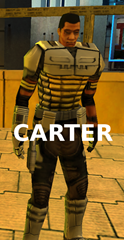
ptn-carter Carter is the team-leader. He's no genius, but he gets the job done. His palm-print is registered in the city's security databases. Doors open for him that are closed for others.

Minoko is the team's hacker, and may well be a genius, albeit a soft-spoken one. She can access systems where Carter's palm-print is unwelcome.

Andre is the flippant team-technician. If it's broken, Andre's a smart bet to fix it with his handy Omni-tool.
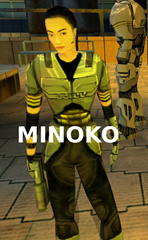
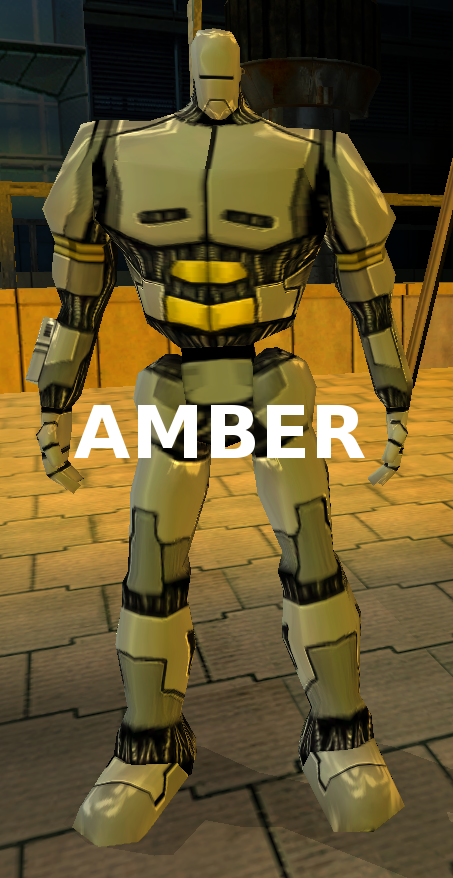
ptn-minoko Lastly, there's Amber. Little more than a teen, her brain was placed in a robot body after a severe accident. An enormous and well-armed and armored cyborg, she can stride boldly where fleshy angels fear to tread, resistant to gas, extremes of temperature, electrical shocks, and a variety of unpleasantness.

At any moment, you command one of the team members, and the others either follow you, or wait for you at your option. The game is played in third-person or first-person at your option. Third-person is generally preferable, as that extra awareness of your surroundings can be very helpful.
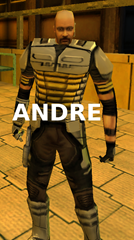
ptn-andre Project Eden is part adventure, part puzzler, with no death-penalty. If a character's health is depleted, they will be reassembled/regenerated at the last UPA regenerator that they passed. If things go awry you can always try again, or try something different. UPA rechargers are also scattered about. Most of what the team do, aside from the purely physical, consumes some energy. Keeping track of where you can get recharged is important. Often rechargers aren't far from regenerators.

The game starts out simply, with your controller back in headquarters feeding you mission objectives and information as you go. Initial tasks and obstacles are overcome using one or another team-member's particular strengths or skills. Repairs and hacking each constitute a small mini-game which requires a little in the way of reflexes, but are fairly undemanding. You'll be doing quite a bit of exploring through increasingly dystopian environments, but we all love that sort of thing, right?

ptn-amber Later on, you will need to make increasing use of your team. Minoko may need to hack and remain connected to a system to allow Amber to traverse a hazardous environment to hold a lever down, that allows Andre to pass safely to repair a broken system, that will allow Carter through to unlock a security-coded door, which will ultimately allow the team to proceed towards its objective.

But it's okay, we work up to that, and it makes sense. Such puzzles aren't arbitrary in feel. They feel logical, and are an extension of the environment. That makes you feel less like you're solving a puzzle,  and more like you're solving problems. That's a very satisfying feeling, and that feeling's multiplied by the fact that the problems are just hard enough. You might need a few goes at things (and some regenerations) to figure out a way to apply your team to move forward, but it is definitely worth it.

During the course of the game you'll also wind up with two remote drones. One that flies and one that rolls around on little treads. The flying drone has a limited range but can be used to scout ahead, explore inaccessible places and press buttons or manipulate other simple controls.

You'll also meet up with gangers, hostile animals and... other things. Combat will occur now and again, but isn't really going to cause you that much of a problem. Partly because of the lack of death-penalty, partly because shooting things doesn't require awesome precision or reflexes, and partly because the three members of your team that you are currently not actively controlling will open fire if they sight hostiles, and will do a generally good job of dealing with bad guys.

project-eden-main

Between messages from your controller, simple conversations with citizens, and events and circumstances as the UPA team descends further and further below 'city limits', the story begins to slowly unfold and a number of mysteries are revealed. It's a solid story and a good adventure, and it wouldn't go astray as a film.

Project Eden's graphics and sound system can stress some older PCs, but you don't have one anymore, do you? Besides, it ran just fine on my 8-year-old PC. I just had to turn the graphic settings down a little. On a new shiny powerhouse system, you can crank those settings right up, and it's wide-screen friendly (16:9 and 16:10) as well as full-frame (4:3).
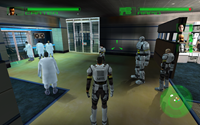
ptn-pe2 Now we get to the sweetest part of the deal.

Cooperative multi-player!

You and up to three of your friends can sit down and play the game each on your own PC. Just figure out who you want to control and share the spare characters (if any) among you. The game supports TCP/IP and IPX networking. There are occasional synchronization problems, but you can save the game and reload it if things go awry.

Seriously, it's awesome to play with friends. Every character gets their moment to shine, regularly, although the game won't last nearly as long is it does if you're playing it on your own. It's just so much faster to explore and solve problems with a group.

The v1.02 patch (which you'll want anyway) fixes almost every issue the game has. You'll definitely want to grab that. You can grab the full game from a variety of places online, or generally pay $10 or less (I've seen it for as little as $3) for one of the spares that your local game-retailer probably has. The full game install runs just fine on Windows XP and will only take about 500MB of your hard-drive space.

This is a game that's almost begging for a sequel. Surely there are other stories to be told.

Play it now.

Saturday, May 02, 2009

Board-game culture, video-game culture, branding and quality

I confess to being rather fond of Greg Costikyan. I've been quite the admirer of his work for more than two decades now. He's smart, witty, deliciously untrustworthy, and (I think) rather strikingly handsome.

In a recent column at Play This Thing, Costikyan talks about board games. He's got some darn fine points and comparisons, though I don't necessarily completely agree with every single one of them in full. Enthusiasts should go read his column now. I'll still be here when you get back. If you're in a rush, just read on.

Let's cut to the heart of the matter:

Costikyan: If the audience has no aesthetic, no basis on which to judge the intrinsic worth of a work, on what basis do they make purchasing decisions? There are only two ways to reach them, in fact. One is by marketing "old favorites," games with brand recognition because of their long history and exposure to the market. The other is by exploiting a licensed brand.

The English-speaking market for quality board-games (and I'm including some tabletop games in that) hit a bit of a Golden Age in the 1980s. I still have many fine examples stowed away. These days, though, the existence of a contemporary, board-game of quality -- and I'll basically define quality here as "does not suck" -- comes from two basic sources: Niche publishing, and Germany.

Boxes of Scrabble, Monopoly, and Hungry, Hungry Hippos can hardly be called contemporary. They're time-worn enough that they can't be killed with a stick.

Why Germany, I hear you cry.

Because they're keen enough on board-games there that they get mainstream reviews. There's an informed buying public. Chances are, the last nifty, innovative board-game you played was translated from the German original (unless you haven't played one since the aforementioned Golden Age).

Costikyan: In Germany, there is what you might call a national boardgame culture, with major publications reviewing new games, a highly competitive set of publishers, and designers who are minor celebrities. Consequently, many, perhaps most, of the best new boardgames are published out of Germany, and the American market is treated to the same old branded crap.

We do, at least, have something of a videogame culture; major media do pay attention to them, and there are innumerable sites devoted to them. And gamers passionately debate the merits of the games they play. And yet, those discussions are curiously uncultured, too; the average gamer's ignorance of the history of the form, of the contributions of different creators, of the evolution of genres, is staggering. Games suck or rock; no nuance here. And gamers have been trained to expect and reward spectacle over originality; the number of commercially viable genres continues to decline over time.

You have three basic factors at work in the push to make sales from either video games or board-games: Branding, spectacle and quality. Board-games don't entirely lack the opportunity for spectacle. There are DVD-games, miniatures and other aspects where you can bring in spectacle.

When the the brand (and/or the spectacle) excessively dominates the quality, though, you get... well, dreck.

Generally branding is likely to be more expensive than quality and innovation, but requires significantly less thought, and shorter timelines. Whack the name of Hannah Montana, NCAA, John Madden on the box, and you can profit from unfinished or unplayable games, or games that would drive a five-year-old to view their math homework as favourable entertainment.

Yes, I'm looking right at you, Electronic Arts.

Why does this work? Year after year, we buy the next video game of a series that has disappointed nearly every year. Actually, only a very few of us are able to hold hope out quite that long. We drop out of the customer pool over time. Our places are taken up by people who see the brand and make unwarranted assumptions about the quality.

Marketing cheat: If you can get quality linked to your brand somewhere along the line, even briefly then you can ignore that pesky quality for years, or even decades before the connection starts to erode, and you have to repeat the process. People will buy defective crud -- over and over sometimes -- if you have managed to link quality with your brand in their minds.

Social media isn't terribly effective at messing this up, either, as some savvy marketers astroturf their way to obfuscation. Who do you even trust to give you useful reviews of games? A majority of the games are flawed (sometimes fatally), and trustworthy reviews may not become available until after brand and spectacle have already worked their magic on you at retail.

Video-games are becoming increasingly mainstream, but that progress is significantly hindered by the industry that produces those games. It's a bit of a vicious paradox, and one that's probably going to bite us all quite a few more times before it manages to resolve itself.

Classic customer service

So, there's this guy in World of Warcraft who'd had his account hacked and some characters swiped. Eventually (after a very very long time) Blizzard gets around to restoring the characters. Of course the characters' original items and gear were long gone, but Blizaard tends to put a sort of randomish sort of loot on restored characters, so you've at least got something to go on with.

One of the items Blizzard apparently furnished was a shirt. Not just any shirt, though, a shirt that kills all the enemies within 30 feet, with 100 uses. Something that, it seems, players aren't supposed to have. Blizzard use it for testing purposes.

Probably the item shouldn't be in the live-game object database, but heck - Blizzard gave it to him, and he tried it out. Not a big surprise there.

Every member of his guild got a 24 hour suspension, and the player himself has been banned. For cheating. My co-workers over at WoW Insider have an interview with the poor bugger.

Now that's classic customer service.

Friday, May 01, 2009

I may not know much about socmedia, but I know what I like

A gold star goes to Domino's Australia (the pizza chain) for their twitter account. You see, most companies who get on to social media basically think of it as yet another one-way medium to broadcast hopeful messages to the already-faithful.

Domino's Pizza Enterprises (and a few others) do something that I actually appreciate: They actually communicate and converse. Sure, some of the tweets are just fluff, but they respond when addressed, answer questions, they provide a point-of-contact for complaints, and whoever it is at the keyboard makes an effort to advocate within the business for the people who have had problems or bad experiences.

That's pleasantly refreshing, and if you're doing that, you've got my interest and quite possibly my attention as well.

The fascination of decay

What's the fascination with decay, crumbling dystopias and abandoned or ruined urban landscapes?

The answer, dear readers, is mystery.

"Unspoiled" nature and everyday-use urban settings are what they are. Something abandoned or in ruins, however was something, and it may not be immediately apparent as to quite what.

0000006204

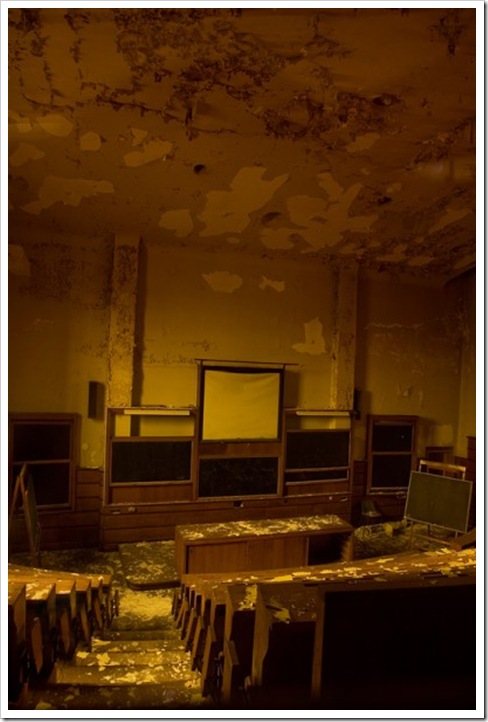
What is this place? What was it? Why was it left? How did it get to be in that state? (It's called Université de Dubois, though that is a pseudonym. One of the lecture halls)

As we look at the world, the mind forms stories around the mysteries it sees to try to answer the questions. And there's no better source of those stories and that intrigue than the familiar fallen into disuse and ruin.

As a species, we love this sort of thing. So much so that we create new ruins in virtual environments like Second Life, from dilapidated buildings to crumbling cities and abandoned subways. These settings are a treat for the imagination, and a delicious dessert for our logical and speculative faculties.

Check out Opacity, Action Squad,  or Forbidden Places for a taste of more.

(Thanks to Bill Harris for publicizing this shot)

Valve suing Activision. Obligation shouldn't be that difficult a concept

Back in 2002, Valve had a bit of a dustup with Sierra over royalties. The original lawsuit went to arbitration, and after reviewing the case the arbitrator decided that Sierra should pay Valve US$2,391,932. It was less than Valve wanted to get, and more than Sierra wanted to pay, but everyone signed off on it anyway.

Fast-forward. Sierra was a part of Vivendi, and as a part of the merger last year, that debt is now a part of Activision-Blizzard.

So, Activision cuts the cheque to Valve, but for only US$1,967,796, basically because they felt that they'd overpaid Valve US$424,136 in previous years. Valve, for their part is filing a suit because Activision is not paying the agreed-on amount.

Now, that's a classic piece of stupid on Activision's part. The smart way to go, if they have indeed overpaid Valve previously, is to pay the originally agreed-on amount (US$2,391,932). That immediately closes their obligation with respect to the 2002 decision. Then they can file a lawsuit, or seek arbitration, or get Valve to agree to pay up, or to take a lesser sum of future payments. Whatever. They're in the clear, and their legal position is solid.

But, no. That would be too easy.

Instead they short-pay, essentially failing to meet their legal obligations, which opens them up to a lawsuit -- and potentially to the forfeiture of the US$424K (and perhaps more).

It makes me wonder if Activision's suddenly so desperate for cash that the US$424K is just out of their reach -- or if Big Bird is making the calls here. Actually, no - getting this right just isn't that complicated. It's at the Sesame Street level of responsibility and obligation. Big Bird could probably have handled this one just fine and still managed to sing an uplifting song about it.