Click here for the Dwell On It, Second Life comic archives!

We have moved!


(pardon our dust)

Showing posts with label maundering. Show all posts

Friday, May 01, 2009

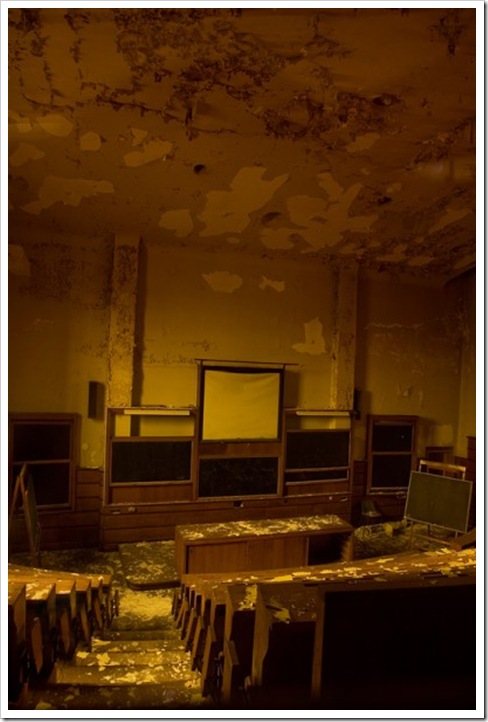
The fascination of decay

What's the fascination with decay, crumbling dystopias and abandoned or ruined urban landscapes?

The answer, dear readers, is mystery.

"Unspoiled" nature and everyday-use urban settings are what they are. Something abandoned or in ruins, however was something, and it may not be immediately apparent as to quite what.

0000006204

What is this place? What was it? Why was it left? How did it get to be in that state? (It's called Université de Dubois, though that is a pseudonym. One of the lecture halls)

As we look at the world, the mind forms stories around the mysteries it sees to try to answer the questions. And there's no better source of those stories and that intrigue than the familiar fallen into disuse and ruin.

As a species, we love this sort of thing. So much so that we create new ruins in virtual environments like Second Life, from dilapidated buildings to crumbling cities and abandoned subways. These settings are a treat for the imagination, and a delicious dessert for our logical and speculative faculties.

Check out Opacity, Action Squad,  or Forbidden Places for a taste of more.

(Thanks to Bill Harris for publicizing this shot)

Thursday, April 30, 2009

Security vs everyone

Security and ease-of-use tend to be mutually exclusive, it's said. Security is stuck in a two-front war, not only are there Bad Guys to keep out, but the authorized users will usually do almost everything possible to defeat the security measures that are intended to keep the Bad Guys out. In a sense, IT-security is generally fighting bigger battles with its customers than they are with the bad guys.

Corporate users write their login credentials down, use easy-to-guess passwords or passwords that can be cracked in fractions of a second, use the same password for everything, want unrestricted access from anywhere without any of that complicated password nonsense, install software that compromises their systems, write down login names and passwords and stick them to their laptops, leave those laptops unattended, plug in wireless access points or random modems on the network, or even just give away their passwords in the street for the asking. Seriously.

Most corporate computer users treat the IT or IT-security team as "the enemy". That's actually the word that is most commonly used when referring to them. The IT people are in a bit of a deadly bind here. The rest of the company is generally working so hard to compromise the security of the network and their desktop systems, that it can be an almost impossible chore to actually keep the bad guys out of the network. Then data gets stolen, or systems compromised anyway.

At one corporation I worked for, a company executive brought in a piece of software that wasn't licensed, and installed it on a desktop system in the warehouse. The software was made by a competitor across the street. Over the next few months, the unlicensed software (which was used for booking, labeling and invoicing deliveries and pickups of shipments) sent all of the information it handled across the street to servers at the rival company in periodic batches.

Armed with information about customers, shipments, rates and so on, the rival could offer sweeter deals and steal business away. And they did.

Business plummeted. Hundreds of thousands of dollars in regular business was lost. Of course the rogue software got removed, once it was discovered, right?

No.

The executive refused to uninstall or replace the software, because it would cost around $3,000 to replace. Also he refused to allow the firewall to be configured to prevent the data-transmissions, because that would interfere with certain conveniences demanded by the sales staff.

A solution was eventually found, but only at the cost of nearly all of the company's warehousing business. Why didn't the CTO or the IT department override him, being that it was a technology/security matter? Because he was the director in charge of them. Besides, they had their hands full, because a branch manager in another state had given another competitor dialup access to the local network and share-drives, because he "couldn't be bothered with all those email attachments."

Oh, there was far, far worse.

The thing is that when it comes to computers people want instant, they want convenient, and they want locks without keys (and ideally doors without locks - and perhaps without doors). Computers allow us to get so much done, so much faster that we want everything to be fast. Every moment typing or remembering a passphrase is an impediment - a barrier to getting the job done, or to getting out of the office at 5.

That sort of poor computer hygiene doesn't just live in the office. People's home computers, well they manage their own security for that. It's hard to find a home computer that isn't infected with something, and frequently with many somethings.

Nobody cares until they lose all their data, or their World of Warcraft gold and equipment, or their Second Life account -- and then they want to blame someone else for it. You didn't do enough to protect them.

The bad guys win more often than they lose - because we, as users, make it easy for them to win. We insist that others do all the work for us, and then we don't let them do their jobs. You don't have to become an expert in either computers or security, but if you learn just a little about how to take care of yourself, your computer and your passwords, your whole IT department can relax a little and actually allow some of the things that they're presently forced to block or prevent.

You can make things easier for you. For everyone.

Thursday, April 23, 2009

Voice direction for word splicing

Ever been really hacked-off by those machines that put sentences together by splicing words? Telephone recordings, elevators, that sort of thing? Even if you've got a good ear, they're generally really annoying to listen to.

The solution to them is also very simple, yet nobody seems to ever do it.

There are two major ways of stressing a word in normal speech. Say "nine seven nine".

No, really. Give it a try.

See how the first nine sounds different from the last nine? The first nine and the seven use ongoing stress emphasis. That's the way we say a word when another word is going to follow it. The last nine uses a different emphasis, because you're going to stop speaking. It's how we sound words that occur at the end of sentences, or when we're otherwise done speaking. So there are two ways to say a word: Regular and final.

Those devices that speak by splicing together words always use only finals. Essentially, the person they recorded spoke each word as a standalone (final) word. Those were recorded, and chopped up and stored for the software to reproduce.

Wrong!

To get it to sound right, and to sound more natural, you record the speaker using regular emphasis.

Get them to repeat the word several times as a sentence, and chop out one from the middle that you like. Then you take the last one, and record that as a final. That gives you two sound-banks of recorded words. One set of regulars, and one set of finals. Then it's just a matter of setting up your data tables for each sentence to select a regular for each word, except the last word of a sentence, and pick the sound out of the list of finals for that one.

It sounds so much more natural, is easier on the ear and requires less concentration to understand. It's also quite simple, doesn't add much to the time with your voice-actor, and only requires double the storage (and in many of these systems, the storage is vastly underutilized).

So why does nobody ever actually do this?

Tuesday, April 21, 2009

The migratory habits of the PR flack

I believe there is some genetic instinct at work. Some deep and unreasoning drive, the exact purpose of which remains unfathomable, inscrutable, and involuted.


Observe the career PR flack. As a press-release approaches actual... well, release the PR flack is overcome with a restless sort of urge. Once the material is released unto the wild lands of journalists and writers, there seems to be some irresistable, and ineluctable prepossession that takes hold.

It is a migratory instinct that cannot be deferred or denied, driving our hapless flack to a seminar, a a conference, a cruise, a flight to Nepal, or a hiking trip to Guam. Pretty much anywhere where you can't actually contact them by any means more swift or certain than a carrier-snail.

What bizarre and recondite twists of genetic predisposition underpin this unstoppable, and indeed almost axiomatic force? Perhaps the world will never know.

Tuesday, April 14, 2009

Watch out for those carrot-eating cyclists on TV

Given that the number of gamers worldwide who have played or presently play violent video games is roughly estimated to be somewhere around 250 million, and the number of shootings, school shootings and violent crimes associated with violent video games is (roughly) 10-20 per year....

Would that not suggest that there is some alternative explanation for these outbursts of violence than the video games?

In fact, there's a far stronger correlation between violent crimes and eating carrots, or riding bicycles than there is for video games.

Besides, didn't we used to blame these shootings on television? When did we stop blaming TV for violent crimes?

Monday, April 13, 2009

Piracy is stealing. Not!

Just about every time I put a DVD in, or tune in to commercial television, I see a cautionary advert that says (either) "Piracy is theft" or "Piracy is stealing", or "Piracy is a crime". These relate to movies, music, software. You hear and see these messages a lot.

Now, it might seem unreasonably pedantic, but those statements are misleading. That is, taken literally, they are false.

Theft, and stealing are crimes (actually, they're not always crimes, but they usually are). Theft is... well:

  1. A person steals if he dishonestly appropriates property belonging to another with the intention of permanently depriving the other of it.
  2. A person who steals is guilty of theft; and "thief" shall be construed accordingly.

Look closely: "with the intention of permanently depriving the other of it"

If someone takes your keys, they are stealing. If someone shoplifts a product from a shelf, they are stealing. If someone takes your car, they are stealing. Each of these deprives the owner of the thing that is stolen. Watch? Wallet? Shoes? Fanny-pack? Jewelry? Luggage? Stealing.

If someone rips your texture, photocopies your book, copies your files or plagiarizes your words, that is not stealing. You have not been deprived of your texture, data or words.

What it actually is, is an infringement of your civil rights. That's unlawful, and there's no question about it.

Technically though, it isn't actually a crime. It's a civil infringement and not a matter for criminal law (though there are some circumstances where it can be, but they're not really the sorts of circumstances you're likely to run into commonly).

Saying that Piracy is theft/stealing/a crime is what we call hype (exaggeration for effect). It's essentially a false statement. It's also an insulting one, to some degree, because it suggests that you don't know any better. You can say that someone's future profits are being 'stolen', but that's something they don't have yet, and that's a civil action as well, and not stealing as the law defines it.

I guess saying that "Piracy is a violation of the civil rights of others" lacks the sort of punch that gets it onto the front of tee-shirts. But we're not really talking about catchy tee-shirt slogans here.

Trivia note: Until relatively recently, in historical terms, the term piracy (in the intellectual property sense) wasn't applied to what consumers did. It was something that publishers did. A pirate was a publisher who used your work, music, or ideas and didn't compensate you fairly (or at all) for it.

Now I'm not saying that the violation of the civil rights of others is right. I'm just a bit fed up with being bombarded by false statements. Are you?

Sunday, April 12, 2009

Amazon fails

Apparently Amazon has started stripping sales rankings from a lot of the books in its catalogue. A hint of homosexuality, it seems, is the trigger. Gay or lesbian characters or themes.

In response to an enquiry from one of the authors, they indicated that this was due to policy. Publisher's Weekly calls it a glitch, but at least one Amazon employee seems to think it is intentional. If it is a glitch it is a very unfortunately specific (and apparently homophobic) glitch.

I'm seriously not at all sure I'd buy the glitch story. If it is, then I think Amazon needs to stop just saying "Yeah, it's a glitch" and start telling people when they expect things to be corrected.

Tuesday, January 01, 2008

Made it!

Well, I made it to the new year. 2008. Wow. For quite a while there, I was pretty sure I wasn't going to get through 2007.

My income comes, basically, from two essential sources. Inworld income (sales, consulting and so forth), and from writing. Essentially, Second Life puts food on the table, and keeps the bills and mortgage paid.

Sure - there's not exactly much of anything left over afterwards, but keeping a family of three is an accomplishment in and of itself.

It's not glamorous to pinch your pennies, or live on cheap foods, or walk instead of spending on public transport. Success, though, isn't measured in glamour. Nor is success a goal. You don't succeed and then suddenly stop, just coasting in the zone for the rest of your life.

Success is a journey, not a goal. I'm fairly poor, sure, but I have everything I have to have to make it to tomorrow. Tomorrow, I'll work on the day after. That's how it goes.

Do remember, that what you want is not the same as what you need. Your needs are what you have to have. Your wants are what you can do without - and you can be happy without the majority of your wants - just focus on the needs, and go from there.

Every day.

Wednesday, December 19, 2007

On insecurity

While insecurity has it's dark sides, it ultimately is doubt - doubt of our own actions; doubt of our own motives; doubt of the rightness of our cause - that drives the constant self-examination that prevents the man from becoming the monster.

Thursday, November 08, 2007

Childhood social outcast, FTW!

It occurs to me that as a child with very, very little social interaction, I missed out on a bunch of things. I never found out that I was supposed to hate broccoli or liver or brussel's sprouts. I found out they were tasty - though sometimes the sprouts were a little bitter.

I never found out that this was supposed to be a man's world, and that women were somehow deficient - or that I should revile people of other cultures, or colours, creeds, politics or religions. So I didn't.

I missed out on all those socializing factors that are supposed to bind me into the basic xenophobic tribal unit. It occurs to me that I don't much think about groups. Not half so much as I think about individuals. The colour of your skin doesn't say anything more about you as a person than who you voted for at the last election or what your shoe size is.

Shoeboxing people is for the lazy and the foolish. To believe that someone looks a certain way or says a certain thing and then to infer everything else about them from that is the worst form of bigoted stereotyping, whether you call them a fascist, a libertarian, a capitalist, a democrat, a republican, a communist or .. hrm ... a few things relating to religion or race that I'd rather not write here. Those labels are all just sloppy thinking to avoid the effort of treating people as individuals. The bad habit of demagoguery.

And it's one we learn at a very early age. We learn it from each-other. All those little absolutes. Then we spend a lifetime trying to get over them if we're lucky enough to even realize that they're there.

None of us are immune. I'm glad my infection as a child was relatively minor. At least I hope it was.

Tuesday, July 17, 2007

Mixed Reality Headcount, Week ending July 15, 2007.

Here is the full ranked table of tracked sites for the week ending Sunday July 15, 2007:

Site (* Native reality site)

Est avg hourly visits

Est avg hourly visits (peak hrs)

Estimated total weekly visits

* Phat Cat's Jazzy Blue Lounge 155 176 26,160 (up 5%)
* City of Lost Angels 82 85 13,932 (up 1%)
* New Citizens Incorporated 81 99 13,752 (up 4%)
* Lost Gardens of Apollo 78 105 13,104 (down 1%)
* Independent State of Caledon 66 73 11,217 (new)
* Midgar 57 66 9,648 (up 17%)
* Isle of Lesbos 51 68 8,664 (up 6%)
IBM 49 49 8,280 (down 13%)
* The Shelter 48 55 8,124 (down 8%)
The Pond 38 24 6,420 (down 6%)
The L Word 31 31 5,316 (down 6%)
Pontiac 29 37 4,944 (down 21%)
* Ballers City 25 29 4,320 (stable)
* Svarga 22 29 3,780 (up 1%)
The Weather Channel 17 23 2,904 (up 8%)
Nissan 15 15 2,580 (stable)
ABC Island 13 8.0 2,304 (up 7%)
Microsoft 13 14 2,196 (down 9%)
Playboy 9.0 8.29 1,512 (down 14%)
Virtual Holland 6.64 12 1,116 (down 26%)
STA Travel 5.64 12 948 (down 38%)
NBA 5.14 6.57 864 (stable)
AOL Pointe 3.14 4.0 528 (down 39%)
Useful Technology 2.43 2.0 408 (down 17%)
Ratepoint 2.36 5.43 396 (up 43%)
Dell 2.29 2.0 384 (up 68%)
Coldwell Banker 1.79 2.57 300 (down 10%)
Sun Microsystems 1.29 3.43 216 (down 33%)
Comcast 1.14 1.43 192 (up 60%)
Adidas 1.14 1.14 192 (down 11%)
Reebok 0.86 2.0 144 (down 29%)
Coca Cola 0.21 0.0 36 (down 40%)

The top ten, with commentary is posted to New World Notes.

Methodology

Mixed reality sites in this headcount are selected for their prominence, either from publicity or real world name recognition. Sites with consistent low traffic (500 or less weekly) may be dropped in future Headcounts in favor of other sites. We do not count sites with camping chairs, or visitors in the orientation sims, as there seems to be little evidence to suggest that they will become visitors to the parent site - and if they do, we catch them when we headcount the site anyway.

We collect data four times per day for each site at 2am, 8am, 2pm and 8pm (times in SLT/US Pacific) plus/minus 1 hour. For each sample we count the number of people at the site at the time. We average those samples across the week, and then assume that average to hold constant, with each visitor spending a half hour on-site. This methodology does not necessarily include one-time events that generate high traffic missed by our sampling, which we'll make note of whenever possible. Headcounts do not factor in returning visitors, so assume that the total number of unique Residents are likely to be significantly less than the estimated total visits.

Thursday, May 24, 2007

Lost for words

I hate writing out a thoughtful comment on a blog, hitting the submit/post button and having the page refresh, my words gone forever. It happens just often enough to be frustrating, and infrequently enough for me not to think about selecting and copying the text into a paste buffer before submitting it.

Wednesday, May 23, 2007

Why would that make it any less real?

Fred Gallagher nails it right on the head.

Harassment

The most common piece of advice that people who are being harassed (sexually or otherwise) get is, essentially, some variation of "Get over it, you pathetic weakling."

The wording and emotional shading may change, but the message remains the same. You're too sensitive. It's your fault. She was asking for it.

Everyone's got their Achilles' Heel - and often more than one. Some well worn track past all your barriers of intellect and self-esteem that cuts straight to your heart. Sometimes you'd think of them as phobias, if they cause unreasoning fear. Some of them lock the spirit into a repeating emotional pattern from which it is hard to escape, reliving the patterns of former misery.

It might be spiders, clowns, mimes, confinement, pregnancy, sexual advances, the disapproval of a parent, certain kinds of insults, slurs or teasing. Everyone's got pushable buttons that generate emotional responses first, leaving intellect to falteringly chase the ambulance.

Repeated exposure often amounts to reinforcement, deepening the track. The wound doesn't heal and each time it hurts worse than the last. This also means that it can be very subtle. Individual incidents may not seem significant in and of themselves to others. Well, of course they don't. They're not your buttons and they're not happening to you. Turning to others has a pretty well-established history of not working well, and that makes things worse.

A woman in the workplace (let's call her Susan) becomes the focus of unwanted sexual slurs, advances, maybe even inappropriate touching. When Susan works up the courage to talk to her friends about it, the most likely piece of advice she is likely to get is some variation of "Get over it." - You shouldn't let that sort of thing bother you. Just ignore it. It's not as bad as you think it is. Run it off. Grow up!

Can we accept, for the moment, that that is not at all helpful? It's much the same sort of advice that people with clinical depression or clinical anxiety get.

If dealing with harassment was as simple as shrugging it off and ignoring it, we wouldn't have laws and regulations about it. It'd be a non-event. The fact is, that however minor or severe the incident is, it is something you don't have a natural defense against. Quite the opposite.

Harassment is a bit like an allergy. The slightest contact can set you off. You brush against a plant protruding from a fence onto the sidewalk, and within minutes you can be incapacitated. You shy away from situations where that might occur, walking suspiciously on the other side of the sidewalk. You avoid walking in parks. You avoid ever being alone with the boss, or that sleazy coworker. You avoid workplaces like the ones in which you have been harassed before.

You do the smart thing, which is to avoid contact with the thing that causes you harm.

Everyone else tells you to get over it. You're too weak, too sensitive, run it off.

As if.

When you are speaking to the victims of harassment, even if you don't understand, be more accepting - and mind your words. If all you can say is some variation of "Get over it", you're probably better keeping quiet.

Wednesday, February 14, 2007

Bringing in the bucks - Lies and damned lies

Well what did my email bring in yesterday? Well, this for starters:


         OFFICIAL PRIZE NOTIFICATION 

This is to inform you that have been selected for a cash prize of £
1.000.000.00( One million Great British Pounds) , International programs
held on the 11th of Febuary 2007 in the London Uk.

The selection process was carried out through random selection in our
computerized email selection system(ess) from a database of over
250,000 email addresses drawn from all the continents of the world.

The Uk National Lottery is approved by the British Gaming Board and
also Licensed by the The International Association of Gaming Regulators
(IAGR). This lottery is the 3rd of its kind and we intend to
sensitize the public.

But that's not all! There is - as they say - more!


It is with pleasure, honour and respect that I am bringing this business proposal to you and with hope it will be for a mutual benefit to both of us. I am optimistic you wont let down the trust and confidence I will repose in you.
I am MR. PETERSON LAMIDE. One of branch manager of a bank in Accra Ghana.During a routine audit of our Bank, we discovered a dormant account of a foreign contractor who died aboard the Egyptian airline boeing 747 that crashed on 31st October 1999 on its way from New-York to Cairo Egypt. Since then nobody has applied or come forward with claims to our Bank as a family, relation or friend to the affected disaster victim.
The regulations of the Bank stipulates that any account that has not been operational for a period of two years becomes automatically dormant. Now the money of the affected foreign victim has been deposited into an suspense

account in our bank.I MR. PETERSON LAMIDE, needs your assistance by presenting yourself to the bank or making a formal request through me to bank as a relation to the foreign contractor whose account is worth three point one million u.s dollars ($3.1m) in a suspenses account.
This money has been in his account for a period of more than ten years.I MR. PETERSON LAMIDE, assure you of a risk free transaction if only you are willing to help. For your assistance to assist me transfer this money to your account and country, I will like us to share it 50/50 of the whole money and strongly and honestly promise to offset any sundry expenses you might incure during the course of the transaction.
As soon as I get your reply I will proceed to give you all my contacts and all necessary informations with regards to the account.Please your full name, address, telephone are highly needed to enable me proceed the preparation of the transfer with my contacts in the bank.
NB: Remember to keep this proposal secret and confidential because of my position in the Bank. I assure you with my position and contacts in the bank, this money will be lifted into your account hitch free.
Regrads,
Mr. Peterson Lamide


Thanks for your kind err 'regrads', mister Lamide. You have my undisguised contempt as the very detritus of the species. You are cruel, greedy, callous and apparently lazy if your language is anything to go by.

People actually fall for this sort of thing, if you can imagine it. Strangely, people want what they don't truly feel they deserve. The more they think they don't deserve it, the more they want it, and the more they try to convince themselves that they do want it.

And then people fall for stupid crap like this. They listen to lies and ignore the inconsistencies and believe what they want to believe. We all do this at times, when we're lied to. Sometimes in little ways. Sometimes in larger ways.

We're all fools now and again, some more often than others - we believe what we want to, and pave over the inconsistencies, often without even noticing them. When someone clearer-headed tries to reason with us, we bite them or lash out.

Don't be a damned fool. I won't if you won't.

Sunday, January 28, 2007

Getting Rich Quickly

Here's a handy rule to live by, one that will guide you just as well in the physical world, as it does in Second Life.

If you suddenly think you've found an easy, quick way to make a lot of money ... please, get professional help, counseling, whatever. Get a friend to talk sense into you.

There actually is no secret that 'they' don't want you to have, other than hard work, inspiration and persistence pay off. Put in the work required, and you stand a good chance of earning. Don't, and you won't. Holding that notion in your head puts scammers, con-artists and grifters out of business.

Being presented with the notion that you can 'get rich quick' or 'make money fast' means that someone is conning you, and that person might be you.

Tuesday, January 02, 2007

Writing about Second Life

Writing about Second Life is ... fun. Surprisingly fun. I started pretty slowly and made a bunch of mistakes, but it's getting there. It's also nice to be able to get all my legal material fact-checked before I publish it.

The last few days have been pretty bloody awkward, since I've not been able to sit for very long, and I've had to rely on the fact that most of my articles (except the news pieces) are drafted days in advance, where possible.

It's interesting to wake up and feel like you want to write, first thing, and to have that urge last throughout the day. More of a problem to not be able to do it. That sucks.

Thanks for your support, folks. It keeps me going.

Monday, January 01, 2007

Give me less of this

Some days it feels like the most common object that causes me trouble in Second Life is the penis. In that, I suppose, Second Life rhymes with Real Life, where the common penis has often been problematic in one way or another.

Give people the tools to create or draw what they want, and then apply the urge to offend or amuse (others, or only themselves) and it's the penis that keeps returning again and again.

A pity we can't all agree on some common, cross-cultural symbol that means "My intent is to offend you." We've got assorted hand gestures for that (though their meaning varies through different cultures); Another for "I'm using some offensive iconic in an ironic/sarcastic/amusing way."

Because, frankly, I'd love to write fewer news pieces involving a phallus in 2007. I'd like to see fewer people dressed as them. I'd like to see fewer jet-packs shaped like them. Fewer towering structures umm... erected in the shape of them. Fewer guns that look like them.

Less of that stuff, pretty please. Give me towers of ice and frozen flame, bridges of light and plasma, rings of sound. Be original. The basic penis image as 'funny' is a punchline that's about 65,000 years old. As a species, we need a new joke. Honestly.

They're certainly there. They're about as amusing as any other part of the body (being that like all comedy, the humour vests in other aspects) the phallus has a bit of a head start in a couple of elements.

I'm totally ready to move on. Elbow humour! Spleens! Gall bladders, even. Listen to Dave Allen talking about Adam and Eve and the nose, now there's a man that could make any body part funny, and on television.

Sad, perhaps, that most people are more offended by a phallus being boldly presented, than a gun.

"It's bad manners to wave either in one's face without consent." -- Ordinal Malaprop.

Saturday, August 26, 2006

On celebrity and bullies

I don't know quite when I became a celebrity. I don't actually even know why. I seem to be famous for being famous. Well-known for being well-known.


It's not exactly comfortable at times. At times my conversations are bugged by listening devices, my doings discussed on voice-chat, the things I do and the things I say subjected to interminable public discussion, analysis and debate, both inworld and outworld.


Sometimes I'm mobbed by people wanting to talk to me. Other times, I'm told that people are too scared to say hello and speak to me, and sometimes I just get plain criticised and bullied.


Bullies are a minority, but they exist in Second Life, just as anywhere else. The bully's tool, as always, is violence. Violence in actions, emotions, or words. The bully's goal is to attempt to modify your behaviour by use of this force, to make you subservient to his or her will.


On my thirteenth day in-world, I was IMed by a bully, and sent a dose of venom that all but had me quit SL on the spot. It was someone I'd never heard of, but they've been a repeated part of my Second Life ever since. I had no idea who the person was, or even really what it was all about. I was so...shocked, as a new resident to receive such a serving of viputeration – such hate.


I sat there in tears for a minute, and was reaching for CONTROL-Q, ready to abort my Second Life, when I got another random IM from someone whom I had never met, but whose name I had seen. She said some very encouraging things to me – apparently unaware of the onslaught that I'd just received...and because of that, I stayed.


That same bully has been with me ever since – I've since learned who the person is, and know more about them – and they're not alone. People look me up inworld occasionally to tell me just how much they loathe this or that thing that I may or may not have said or done – some are bullies, some are misinformed. Some are obviously both. I get more criticism about things that people think I've done that for things that I've actually done.


The lesson here, though, is not to let someone compel your behaviour by violence, in any form. Physical violence, digital violence, emotional or verbal violence. If you let others control you in this way, you cannot make your own choices, and if you cannot make your own choices, you cannot be true to yourself.


This above all: to thine own self be true,
And it must follow, as the night the day,
Thou canst not then be false to any man.


Friday, August 25, 2006

Weltenshauung

Nowhere do you see the Observer-Expectancy effect, the Subject-Expectancy effect or apophenia than on the internet, and when you bring diverse people into a formative culture, the signs of it become too obvious to miss.


Second Life is like a giant placebo in many respects, or a nocebo - depending entirely on your perspective.


What is Second Life? A game? Yes it is, because if you only judge it based on it's game elements (noting that most game elements in any game are imposed by the player, not the game) then it's certainly a game.


Is it a platform? Well, yes. You could primarily focus on those elements.


A sandbox? Yes.


A social experiment? Yes.


A country? Yes.


A dark conspiracy? Yes.


Deus ex machina? Yes.


Each point of view requires the exclusion or diminution of certain aspects of Second Life. That's up to you, of course, since that happens inside your head.


Reflexivity is an undeniable fact of Second Life. Well - unless you do deny it. Your own perceptions can make it cease to exist within your personal weltenshauung.


What you get out of Second Life is a bit like the double-slit experiment coupled with a heaping helping of Observer-Expectency effect. It really depends on what you put in as to what you get out, and how you view and interpret the results.


In an environment rich with subjective interpretation, apophenia abounds. In a sense, Second Life really is Your World as they say, in much the same way that a Rorshach inkblot is entirely dependent on the viewer.


A new resident comes into Second Life and they're faced with what is probably the most difficult thing they've ever done. There's a complex interface in front of them; A formative, distributed society of - well disparate and distributed societies; Complicated concepts wrapped in obscure slang; A world that is too large to see all of, and that is constantly changing; An open ended system that delivers satisfaction based solely on the resident's ability to select her own path and goals, and stick to them.


Second Life may well be the first piece of non-business software that a resident has been exposed to after minesweeper and freecell.


At best, our residents are not going to see more than a portion of what's going on in Second Life, from day to day, and they're going to see patterns. People see patterns in everything, because that's what our brains do.


More so, we see the patterns we expect to see, and our brains are adept at discarding or distorting data that does not fit.


One thing you can be sure of is that none of us see Second Life as it is. None of us can. What it is, however, is amorphous enough that our position, circumstances and point-of-view greatly affects what we see it as. There are so many diverse elements and aspects that you can focus on. Second Life might be a dull place to you - or a place full of greed and selfishness.


It doesn't have to be.


Just because these things exist, it doesn't mean you have to dwell on them in your second life any more than they deserve, any more than you might feel compelled to make prions the central fact of your first life.