Click here for the Dwell On It, Second Life comic archives!

We have moved!


(pardon our dust)

Showing posts with label Gaming. Show all posts

Sunday, May 10, 2009

Populous, the origin of

"We couldn't sell it to anyone" -- Bullfrog's famous 1989 game, Populous was a huge hit, but it was a serendipitous one. A tiny business making a game without a clear target idea, Bullfrog hit on success with a combination of luck and plain-old hard work.

"Our royalty cheques were due to be paid one quarter in arrears, and we didn’t expect to get any ... The next cheque was for a quarter of a million. I thought it was a mistake at the time. I actually called EA to tell them."

Edge Online has the fascinating tale of how this hit game came about.

Sunday, May 03, 2009

Play it now: Project Eden

The Earth has become overpopulated. Cities just grow up and up and ground-level is something that most people -- the lucky ones -- never get near. Even the rundown and decrepit levels just below the clean, shiny, and urbane upper-city are the turf of the homeless, the hopeless, the diseased and the gangers. And things get just get worse further down.

But there's something brewing. Something calling. A piece of the past that refuses to sleep.

Core Design, which was established in 1988, is a design studio I think of fondly, although the studio is essentially gone these days. The name is still the property of Eidos Interactive who acquired them as a part of CentreGold back in 1996. Core Design was responsible for Tomb Raider, but Project Eden was probably their finest PC game.

You can still find Project Eden in game-store budget bins for just a few dollars (skip the console version, the PC version is vastly superior). The game scored above average reviews, except for Computer Gaming World who gave it a miserable 1.5 out of 5. CGW's influence was fairly widespread then, and coupled with some launch bugs and an astonishing lack of advertising, Project Eden barely sold through at retail despite shipping a lot of copies, making it one of the best games that you've never played.

The story centres on four characters -- members of the Urban Protection Agency (UPA) who are sent to investigate problems at the Real Meat factory (which produces an abundant supply of synthetic meat products). Strange goings-on at the factory are linked to possible gang/terrorist activities, and investigators already sent to the scene have disappeared.

Our UPA team is in for a whole lot more than they bargained for.

Project Eden was released on both the PS2 and the PC. Skip the PS2 version. It is ungainly by comparison. In this game, you will control the four UPA operatives, and are able to switch between each one at the touch of a key.

ptn-carter Carter is the team-leader. He's no genius, but he gets the job done. His palm-print is registered in the city's security databases. Doors open for him that are closed for others.

Minoko is the team's hacker, and may well be a genius, albeit a soft-spoken one. She can access systems where Carter's palm-print is unwelcome.

Andre is the flippant team-technician. If it's broken, Andre's a smart bet to fix it with his handy Omni-tool.

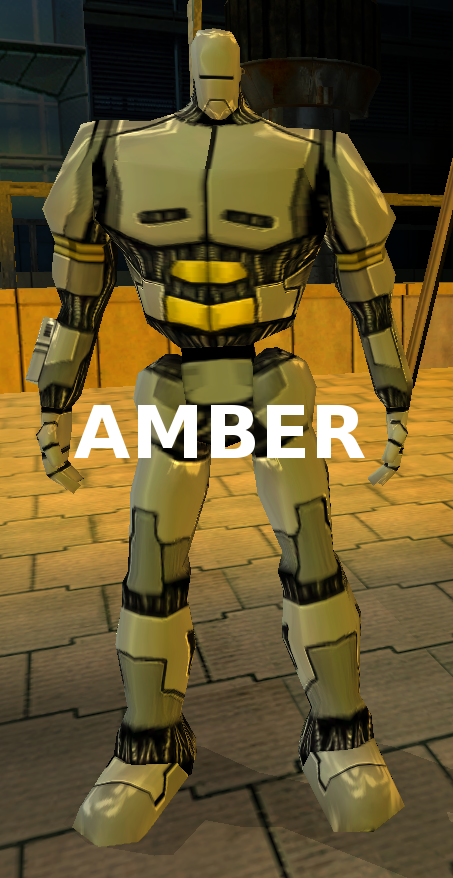
ptn-minoko Lastly, there's Amber. Little more than a teen, her brain was placed in a robot body after a severe accident. An enormous and well-armed and armored cyborg, she can stride boldly where fleshy angels fear to tread, resistant to gas, extremes of temperature, electrical shocks, and a variety of unpleasantness.

At any moment, you command one of the team members, and the others either follow you, or wait for you at your option. The game is played in third-person or first-person at your option. Third-person is generally preferable, as that extra awareness of your surroundings can be very helpful.

ptn-andre Project Eden is part adventure, part puzzler, with no death-penalty. If a character's health is depleted, they will be reassembled/regenerated at the last UPA regenerator that they passed. If things go awry you can always try again, or try something different. UPA rechargers are also scattered about. Most of what the team do, aside from the purely physical, consumes some energy. Keeping track of where you can get recharged is important. Often rechargers aren't far from regenerators.

The game starts out simply, with your controller back in headquarters feeding you mission objectives and information as you go. Initial tasks and obstacles are overcome using one or another team-member's particular strengths or skills. Repairs and hacking each constitute a small mini-game which requires a little in the way of reflexes, but are fairly undemanding. You'll be doing quite a bit of exploring through increasingly dystopian environments, but we all love that sort of thing, right?

ptn-amber Later on, you will need to make increasing use of your team. Minoko may need to hack and remain connected to a system to allow Amber to traverse a hazardous environment to hold a lever down, that allows Andre to pass safely to repair a broken system, that will allow Carter through to unlock a security-coded door, which will ultimately allow the team to proceed towards its objective.

But it's okay, we work up to that, and it makes sense. Such puzzles aren't arbitrary in feel. They feel logical, and are an extension of the environment. That makes you feel less like you're solving a puzzle,  and more like you're solving problems. That's a very satisfying feeling, and that feeling's multiplied by the fact that the problems are just hard enough. You might need a few goes at things (and some regenerations) to figure out a way to apply your team to move forward, but it is definitely worth it.

During the course of the game you'll also wind up with two remote drones. One that flies and one that rolls around on little treads. The flying drone has a limited range but can be used to scout ahead, explore inaccessible places and press buttons or manipulate other simple controls.

You'll also meet up with gangers, hostile animals and... other things. Combat will occur now and again, but isn't really going to cause you that much of a problem. Partly because of the lack of death-penalty, partly because shooting things doesn't require awesome precision or reflexes, and partly because the three members of your team that you are currently not actively controlling will open fire if they sight hostiles, and will do a generally good job of dealing with bad guys.

project-eden-main

Between messages from your controller, simple conversations with citizens, and events and circumstances as the UPA team descends further and further below 'city limits', the story begins to slowly unfold and a number of mysteries are revealed. It's a solid story and a good adventure, and it wouldn't go astray as a film.

Project Eden's graphics and sound system can stress some older PCs, but you don't have one anymore, do you? Besides, it ran just fine on my 8-year-old PC. I just had to turn the graphic settings down a little. On a new shiny powerhouse system, you can crank those settings right up, and it's wide-screen friendly (16:9 and 16:10) as well as full-frame (4:3).

ptn-pe2 Now we get to the sweetest part of the deal.

Cooperative multi-player!

You and up to three of your friends can sit down and play the game each on your own PC. Just figure out who you want to control and share the spare characters (if any) among you. The game supports TCP/IP and IPX networking. There are occasional synchronization problems, but you can save the game and reload it if things go awry.

Seriously, it's awesome to play with friends. Every character gets their moment to shine, regularly, although the game won't last nearly as long is it does if you're playing it on your own. It's just so much faster to explore and solve problems with a group.

The v1.02 patch (which you'll want anyway) fixes almost every issue the game has. You'll definitely want to grab that. You can grab the full game from a variety of places online, or generally pay $10 or less (I've seen it for as little as $3) for one of the spares that your local game-retailer probably has. The full game install runs just fine on Windows XP and will only take about 500MB of your hard-drive space.

This is a game that's almost begging for a sequel. Surely there are other stories to be told.

Play it now.

Saturday, May 02, 2009

Board-game culture, video-game culture, branding and quality

I confess to being rather fond of Greg Costikyan. I've been quite the admirer of his work for more than two decades now. He's smart, witty, deliciously untrustworthy, and (I think) rather strikingly handsome.

In a recent column at Play This Thing, Costikyan talks about board games. He's got some darn fine points and comparisons, though I don't necessarily completely agree with every single one of them in full. Enthusiasts should go read his column now. I'll still be here when you get back. If you're in a rush, just read on.

Let's cut to the heart of the matter:

Costikyan: If the audience has no aesthetic, no basis on which to judge the intrinsic worth of a work, on what basis do they make purchasing decisions? There are only two ways to reach them, in fact. One is by marketing "old favorites," games with brand recognition because of their long history and exposure to the market. The other is by exploiting a licensed brand.

The English-speaking market for quality board-games (and I'm including some tabletop games in that) hit a bit of a Golden Age in the 1980s. I still have many fine examples stowed away. These days, though, the existence of a contemporary, board-game of quality -- and I'll basically define quality here as "does not suck" -- comes from two basic sources: Niche publishing, and Germany.

Boxes of Scrabble, Monopoly, and Hungry, Hungry Hippos can hardly be called contemporary. They're time-worn enough that they can't be killed with a stick.

Why Germany, I hear you cry.

Because they're keen enough on board-games there that they get mainstream reviews. There's an informed buying public. Chances are, the last nifty, innovative board-game you played was translated from the German original (unless you haven't played one since the aforementioned Golden Age).

Costikyan: In Germany, there is what you might call a national boardgame culture, with major publications reviewing new games, a highly competitive set of publishers, and designers who are minor celebrities. Consequently, many, perhaps most, of the best new boardgames are published out of Germany, and the American market is treated to the same old branded crap.

We do, at least, have something of a videogame culture; major media do pay attention to them, and there are innumerable sites devoted to them. And gamers passionately debate the merits of the games they play. And yet, those discussions are curiously uncultured, too; the average gamer's ignorance of the history of the form, of the contributions of different creators, of the evolution of genres, is staggering. Games suck or rock; no nuance here. And gamers have been trained to expect and reward spectacle over originality; the number of commercially viable genres continues to decline over time.

You have three basic factors at work in the push to make sales from either video games or board-games: Branding, spectacle and quality. Board-games don't entirely lack the opportunity for spectacle. There are DVD-games, miniatures and other aspects where you can bring in spectacle.

When the the brand (and/or the spectacle) excessively dominates the quality, though, you get... well, dreck.

Generally branding is likely to be more expensive than quality and innovation, but requires significantly less thought, and shorter timelines. Whack the name of Hannah Montana, NCAA, John Madden on the box, and you can profit from unfinished or unplayable games, or games that would drive a five-year-old to view their math homework as favourable entertainment.

Yes, I'm looking right at you, Electronic Arts.

Why does this work? Year after year, we buy the next video game of a series that has disappointed nearly every year. Actually, only a very few of us are able to hold hope out quite that long. We drop out of the customer pool over time. Our places are taken up by people who see the brand and make unwarranted assumptions about the quality.

Marketing cheat: If you can get quality linked to your brand somewhere along the line, even briefly then you can ignore that pesky quality for years, or even decades before the connection starts to erode, and you have to repeat the process. People will buy defective crud -- over and over sometimes -- if you have managed to link quality with your brand in their minds.

Social media isn't terribly effective at messing this up, either, as some savvy marketers astroturf their way to obfuscation. Who do you even trust to give you useful reviews of games? A majority of the games are flawed (sometimes fatally), and trustworthy reviews may not become available until after brand and spectacle have already worked their magic on you at retail.

Video-games are becoming increasingly mainstream, but that progress is significantly hindered by the industry that produces those games. It's a bit of a vicious paradox, and one that's probably going to bite us all quite a few more times before it manages to resolve itself.

Classic customer service

So, there's this guy in World of Warcraft who'd had his account hacked and some characters swiped. Eventually (after a very very long time) Blizzard gets around to restoring the characters. Of course the characters' original items and gear were long gone, but Blizaard tends to put a sort of randomish sort of loot on restored characters, so you've at least got something to go on with.

One of the items Blizzard apparently furnished was a shirt. Not just any shirt, though, a shirt that kills all the enemies within 30 feet, with 100 uses. Something that, it seems, players aren't supposed to have. Blizzard use it for testing purposes.

Probably the item shouldn't be in the live-game object database, but heck - Blizzard gave it to him, and he tried it out. Not a big surprise there.

Every member of his guild got a 24 hour suspension, and the player himself has been banned. For cheating. My co-workers over at WoW Insider have an interview with the poor bugger.

Now that's classic customer service.

Friday, May 01, 2009

Valve suing Activision. Obligation shouldn't be that difficult a concept

Back in 2002, Valve had a bit of a dustup with Sierra over royalties. The original lawsuit went to arbitration, and after reviewing the case the arbitrator decided that Sierra should pay Valve US$2,391,932. It was less than Valve wanted to get, and more than Sierra wanted to pay, but everyone signed off on it anyway.

Fast-forward. Sierra was a part of Vivendi, and as a part of the merger last year, that debt is now a part of Activision-Blizzard.

So, Activision cuts the cheque to Valve, but for only US$1,967,796, basically because they felt that they'd overpaid Valve US$424,136 in previous years. Valve, for their part is filing a suit because Activision is not paying the agreed-on amount.

Now, that's a classic piece of stupid on Activision's part. The smart way to go, if they have indeed overpaid Valve previously, is to pay the originally agreed-on amount (US$2,391,932). That immediately closes their obligation with respect to the 2002 decision. Then they can file a lawsuit, or seek arbitration, or get Valve to agree to pay up, or to take a lesser sum of future payments. Whatever. They're in the clear, and their legal position is solid.

But, no. That would be too easy.

Instead they short-pay, essentially failing to meet their legal obligations, which opens them up to a lawsuit -- and potentially to the forfeiture of the US$424K (and perhaps more).

It makes me wonder if Activision's suddenly so desperate for cash that the US$424K is just out of their reach -- or if Big Bird is making the calls here. Actually, no - getting this right just isn't that complicated. It's at the Sesame Street level of responsibility and obligation. Big Bird could probably have handled this one just fine and still managed to sing an uplifting song about it.

Wednesday, April 29, 2009

Play it now: Four free Big Fish games


Big Fish Games have several titles available for free download for a limited time. AzadaHidden Expedition: Everest, Fairway Solitaire, and Spa Mania. All four titles are available for both Windows and Mac. You'll need to create a free account at Big Fish Games in order to take advantage of the special coupon codes, but it is all fairly smooth sailing other than that.

Azada is a puzzle game, Hidden Expedition: Everest is a hidden object game, Spa Mania is a time-management game, and Fairway Solitaire is a surprisingly well-crafted fusion of a golf-game and a card game which I've had my eye on for some time. I've linked in some reviews above so you have some idea what you're getting.

Purchase instructions, links and the coupon codes for getting them gratis are available on Jayisgames. Enjoy.

Wednesday, April 22, 2009

Play it now: Virtual Apple


For the impatient, let's start with Virtual Apple is awesome and you should run off and tinker with it right away.

For anyone who is still left, Virtual Apple is really awesome. Off you go!

Wait, what? Some of you are still here? Oh, alright then.

Virtual Apple is a Web-site with over 1300 Apple II and Apple IIgs disk images, and an embedded emulator that works on most browsers and systems. You can play a lot of old Apple II games from the 1980s right in your Web-browser, or you can download disk images from the site to work with a local emulator.

For simpler games, you can just load the page and start playing. For more complex ones (games that require custom player disks and the like) you might want to download the images and an emulator for your system... but Virtual Apple allows you to sample most of these treats before committing to the (admittedly microscopic in modern terms) download. One or two of the images online won't work due to copy protection (Earth Orbit Stations comes to mind) but a local emulator may be able to bypass such fuss.

Yes, Apple II games were not the most sophisticated. It was an 8-bit system with limited sound and graphics capabilities, and very little memory to go on with. That said, you can find some real gameplay treasures in the archive (many of which deserve remaking).

The Web-based emulator itself has gone through numerous revisions, so if you've visited the site in the past but have been away for a while, it is worth checking out again.

Now, go on and get out of here and spend some quality time with Virtual Apple.

Tuesday, April 21, 2009

Play it now: Fallout collection promo


Gog.com is having a Fallout Collection promotion. They're selling the original Fallout, Fallout 2 and Fallout Tactics, DRM-free for US$14.37. That includes some premium content like soundtracks and the 205 page Fallout bible.

Even if you already bought one or more of the originals years ago on disk, that's a darn good deal.

Fallout is fondly remembered by a generation of gamers, and with good reason. The promo ends on midnight, 27 April.

Thompson loses appeal

Judging by the reader figures, Florida ex-attorney Jack Thompson is a popular topic among readers. Given a lifetime disbarment in September 2008 for 27 counts of professional miscondunct, Thompson appealed to the Supreme Court.


Now, these sorts of disbarment appeals happen from time to time. The appeal is first heard by a panel of judges who decide if the appeal will take place. Less than one in 25 are actually permitted so it represented some pretty long odds.

Well, it seems that Thompson doesn't get to be one of the special snowflakes this time around. I can only wonder what he's going to do next. I'm pretty sure he's not going to just let it slide. I can't imagine why you'd want to be a part of a professional association that doesn't want you as a member, though.

Sunday, April 19, 2009

Play it now: Gemcraft Chapter 0


A web-embedded Flash game. GemCraft Chapter 0 is fun and clever, with rather a bit more depth to it than it seems at first. It can suck away a goodly chunk of your time without you realizing it, though.

Saturday, April 18, 2009

Beta-ing

Another week another beta. This time for [can't say because of the NDA]. On the plus side it looks interesting. Whether it holds my attention once I start fiddling with [the other beta I'm supposed to be accessing over the weekend, but can't mention because of the NDA].

On the plus side, there's a lot of exciting stuff in beta at the moment, and I'm more or less looking forward to the release of all of them. On the downside, the restrictions about even mentioning them on my own blog are a bit of a pest.

Sure, the restrictions make sense. Some of this stuff is still pretty shaky in some ways, and they deserve a chance to get that hammered out and polished smooth before release. But still. It'd be nice to say that I'm interested and a bit excited about them, right?

Not being able to mention them puts tedious holes in the social media stream.

Friday, April 17, 2009

Massively's Free Realms beta key giveaway

Over on Massively, we're giving away 100 beta keys for Sony Online Entertainment's Free Realms! If you want one, head on over and get an entry in. You have until 9am ET on Saturday April 18.

Fallout, the television show

Bethesda/Zenimax (you know those folks, The Elder Scrolls, Fallout 3, that sort of thing) registered some new trademarks just recently.

On 5 February 2009, Bethesda Softworks LLC applied for the Fallout trademark for "Entertainment services in the nature of an on-going television program" (s/n 77663853) and for "motion picture films about a post-nuclear apocalyptic world" (s/n 77663852). Obviously they already own all the other US trademarks to do with this game property at present.

Fallout, the film. Or the TV series. Hmm. Interesting notion.

Tuesday, April 14, 2009

Jack spams Utah legislature?

Unhappy with the fate of his the bill he drafted, disbarred Florida attorney Jack Thompson apparently sent enough emails to the Utah senate president Waddoups that he was asked to stop, including an image of GTAIV's protagonist character getting a lap-dance, essentially calling it pornography.

Interestingly enough, the Utah legislature might agree with him in part, because when he sent that to the whole legislature, Waddoups decided to pass the matter on to the State Attorney General to see what action may be taken.

In a sense, Waddoups might be playing into Jacks hand (argh! Did anyone else just go to a scary visual place just then?) with this one. Is it offensive material, or is it not? Or is it just that it is inappropriately out-of-place?

See also:

Utah Senate President Wants to Prosecute Jack Thompson Under CAN-SPAM Act

http://www.sltrib.com/news/ci_12142617

Steam now on Steam

Let me run up at that phrase again. A steampunk machines/cogs/steam/puzzle game on Valve's Steam for Windows. There's also a demo. Tricky, kinda cool, steampunk and relatively cheap. What's not to like?


It's called Cogs, and you should try the demo before making any purchasing decisions. Maybe it's not for you.

Lessons in Future Publishing

So, Edge Online's staff appear to have all quit? Why? Because editorially, it appears that Future Publishing basically wanted the online arm to work editorially just like the print arm.

"Edge-Online's editorial control has been brought in line with the magazine in an effort to create a "strong, consistent voice" for the brand, according to Future Publishing."

Now, Future Publishing... I like you folks. We've got history. You and I go way back, and I'm fond of you. So I'll be gentle.

Dumbass move.

I think that's about as gentle and diplomatic as it gets in this particular case.

What you've basically suggested is the equivalent of saying that there's no effective difference between TV and the cinema screen. Your print arm and your online arm have as much in common as television and cinema -- which is to say a whole lot. The things that they have in common make them strong. The things that they don't have in common make them useful and appropriate and relevant. Each to their own.

Gloss over those differences and you lose usefulness, appropriateness and relevance -- and you'd be economically better off shutting one of those arms down. In fact, that's pretty much what you just did, effectively. Staff gone, and most of the readers will go with them.

Future, you should know better. I always thought you did, in fact. You can have a strength and consistency, but you need different voices for different media. That's an old, old lesson now, from before many of us were born. I believe it's written down somewhere.

Watch out for those carrot-eating cyclists on TV

Given that the number of gamers worldwide who have played or presently play violent video games is roughly estimated to be somewhere around 250 million, and the number of shootings, school shootings and violent crimes associated with violent video games is (roughly) 10-20 per year....

Would that not suggest that there is some alternative explanation for these outbursts of violence than the video games?

In fact, there's a far stronger correlation between violent crimes and eating carrots, or riding bicycles than there is for video games.

Besides, didn't we used to blame these shootings on television? When did we stop blaming TV for violent crimes?

Saturday, April 11, 2009

Brass knuckles

Since there's no controversy about violent video games, and violence and video games, of course Electronic Arts figured it would be a great idea to send out brass knuckles with the promo material for Godfather II.

That's like bungee-jumping using a length of iron chain, you know, to prove it's safe - or some other staggering, self-harming non-sequitur.

As a promotional item, it would come from their marketing department, so we must assume that the marketing department hasn't read a newspaper or watched any TV in, oh, the last ten years or so. Leastways, nothing about - you know - games.

Now EA is trying to take the things back. Turns out that possession of them is a crime in a lot of places in the USA. Sending them across state lines, too. Of course, if they're trying to get people to send them back, are they not now inciting the recipients to break the law by sending the items across state lines a second time?

What the heck was anyone thinking?

Friday, October 24, 2008

Fallout 3: Now 20USD more expensive on Steam

US$69.99. Golly. Thanks to regional pricing, it is US$20 more than you'd pay for the same files via Steam in the USA. If you're in the USA, the same little clicky purchase button will only cost you US$49.99.

In fact -- it is cheaper for me to go to the store (including the cost of gas), buy it off the shelf, and I can still afford to have a meal while I'm at the mall, with the difference.

Oh, and the unlock date. I get to play it a day earlier if I purchase from the store down the  road. (Actually, if you're in the USA the Steam edition unlocks several days earlier than it does here)

Someone actually sat down, and made the decision to price the same software and data-files 40% higher. That's forty percent. Did I mention that it was forty percent more?

Now you could talk exchange rates because our local dollar is a bit soft versus the US dollar right now -- but the thing is, we're being charged in US dollars anyway, so this is 40% after the exchange rate is applied.

I don't see how this is supposed to encourage me to buy the Steam version. Fix the pricing. Then we'll talk.

Maybe publishers could even help make a chunk of the Steam catalogue available outside of North America. That would be nifty too.

But.. baby steps. Let us get that pricing silliness sorted out first.

Thursday, June 28, 2007

Todd Holmdahl demonstrates a train-wreck.

So, you know, I read a bit. The web, blogs, news, that sort of thing. I don't have a fifth gen gaming console, like the Wii, or Xbox-360, or PS3. Those things are way beyond my means, but you see a lot of news about them, bluster, sabre-rattling and failure rates.

It's pretty much axiomatic that after the launch of a new gizmo you'll get a lot of news pieces on the web about failures of this device or that. Too fragile, screen scratches too easily, unit sets fire to the cat, blows up grannies, and so on. It doesn't necessarily mean that there's actually any problem.

Dean Takahashi has a Q&A posted with Xbox hardware guy Todd Holmdahl. Go read it.

Now, this is how you don't deal with a unit-failure issue like this (real or imagined). Reading Holmdahl's responses, the reasonable reader can reasonably infer that there's a huge failure problem. Maybe there isn't, but Holmdahl makes it seem like there is one. He's practically screaming it in your face, so much so that it looks like a really, really big one.

How do you reasonably infer that? Imagine that you were in Holmdahl's position, and there was no problem at all. How would you answer the questions, in that case?

Now compare them with Holmdahl's answers - or perhaps I should say answer (singular) since he's really holding the line on this. See the difference? That difference is a disaster. Either from an actual unit-failures perspective, or from a PR perspective.

Whether there's a problem or not, he's just made a whole lot of people certain there is.