Click here for the Dwell On It, Second Life comic archives!

We have moved!


(pardon our dust)

Sunday, July 30, 2006

9K

9K concurrent residents probably isn't as much news as 10K would be, but it's probably worth a mention.

At Sat Jul 30 19:17:39 SLT 2006 we passed 9K residents in-world.
At Sat Jul 30 19:57:15 SLT 2006 we peaked at 9,613 residents for about 3 minutes.
At Sat Jul 30 20:02:48 SLT 2006 we dipped below 9K again.

That's the first time we topped 9,000 residents, and we went well past that yesterday.

(EDIT: Converted times from UTC to SLT to avoid confusion)

Friday, July 28, 2006

The Usual Suspects

Post "I like pie" on the forums.
Some people will answer that they like pie too.
More people will answer to say that they don't like pie, and why you shouldn't either.
Someone will say that the like (or perhaps the dislike) of pie is a cultural or racial slur.
Someone will mention that Hitler liked (or didn't like) pie.
Someone else will say that they would like to taste pie, but the bugs in it make it inedible.
Insert postings about the availability of pie bringing in more underagers, griefers, furries, goreans, robots, christians, black people, white people, and blue people.
Express worries that the commercialisation of pie will spoil it's flavour.
"Pie wants to be free."
30 people start arguing about things that have nothing to do with pie.

And everyone thinks they're being novel and unpredictable.

Repeat for differing values of Pie.

Exposing yourself...

Don't judge a book by its cover.”

-Proverb


Of course we all know that we shouldn't judge a book by it's cover - a person by their appearance, race or colour – because they couldn't choose or change that, right?

Well, ahoy Second Life!

How can racism, chromatic prejudice or appearance-based bigotry survive in a world where we may all change our face and form and colour at will. From human to robot to animal to ball-of-light to...whatever we please.

What you see is what you get.”

-Proverb

To whatever we please is the key notion here. The shape you choose says something about you (as does your Second Life last name). The choice is not unlimited, and neither are our selection criteria, which further limits the options.

You won't see Tateru as a dancing pile of poop – because I wouldn't choose an appearance like that. Even if you change avatars and appearances at will, on a whim without care for the content, you're exposing yourself. Because you're the kind of person who would do that. The act shows your personality – perhaps more clearly than settling on a single avatar and sticking with it.

The green, red-headed, hairy, overweight misshapen dwarf in lingerie who appeared about two thirds of the way through my class... Is he going to disrupt it?

Answers on a postcard.

In RL we power-dress, and accessorise We select clothing, hairstyles, make-up that projects an image, and makes us feel more confident, in-control, relaxed, whatever. The psychological feedback effects on us are clear, well-documented and very powerful.

In Second Life, we do that with our whole bodies. We not only clothe our avatars, but make them short, tall, old, young, male, female, black, white, blue, green...whatever.

When we present ourselves in the outside world, we select our clothing based on our personality and on the image we want to project. We flip through magazines, watch films and television, and oftentimes select an outfit based on a celebrity or fictional character whose image we want to project. It colours our thinking and allows us to more readily assume the qualities and traits that we want people to see in us – whether we think those traits are there or not. Sexier, cooler, more confident, jaded...

In Second Life, we can turn the volume up.

Are you ready to rock and roll?”

-Star Child

But appearance isn't the only factor here. Just as telling is the dichotomy, when the words and actions of the person don't match the avatar you see. Again, you've exposed a bit more of yourself than you realise.

On the internet, everyone knows you're a dog.”

-Modern Proverb

Second Life last names fall into a similar category. Given the list, many of us chose a specific name for a specific reason. And many of those reasons are the same – though there are always some exceptions. Look at the Overlords, many of whom turned out to be troublesome and/or underage. Or the Alphabetas whose name was first on the list – many of them chose the name because it was first, and they had no special preference. Random choice, of name or appearance still says something about you. Everyone knows you're a dog.

The more we try to hide ourselves, the more obvious our inner selves become to everyone else.

It's funny how heterosexuals have lives and the rest of us have 'lifestyles.'”

-Sonia Johnson

And that brings us full circle. Residents aren't, of course, prejudiced about colour, appearance or race. They're prejudiced about the personalities, priorities, creeds, and conscious or unconscious motivations that that cause us to select those colours, appearances or races.

Oftentimes it happens out of ignorance – but more often from a bipolar certainty about the world. If you're right, then I'm wrong. Certainty allows for no half-measures, or shades of grey, or complex multi-dimensional decision surfaces. If you're not right, you must be wrong – and that would be intolerable.

That's the sort of thing that breeds crusades, jihads, oppression based on gender or sexual orientation, Christmas guilt syndrome, or widespread griefing of furry sims. Just plain, pig-headed certainty that your choices and your views are the right ones, coupled with an unwillingness to question and re-evaluate your position, and a touch of insecurity about your fundamental self-worth.

But don't take my word for it. Use your brain. Look around you. Think. Question yourself and your actions, and look at things from someone else's point of view whenever you can.

"With all things and in all things, we are relatives."

-Sioux saying


Sunday, July 23, 2006

More signs


Saturday, July 15, 2006

Culture Shock works both ways

Whether you're looking at a society, a community or a company, culture-shock is a two-way thing. People don't much care for cultures that are incompatible with their own, and – frankly – they're rarely at their best when confronted with confusion or doubt.


Of course there are many compatible cultures, and compromises and cooperation are the social lubricant that forms functioning communities – either in purely social contexts, or in business structures.


Businesses with strong products, good profits, and excellent business models often go under for issues more than the immediately obvious. Citing cash flow as the cause is like giving the cause of death as her heart stopped. Well, of course that was when things crossed the line. How did it go wrong? Some of these businesses succumb to unmanaged growth. Victims of their own success.


A dozen people may be able to turn over just so much work and business. Business is good, and either profits are too, or you get an injection of venture capital into the works, to take you through from one stable business plateau to the next. There are a number of things that can make the growth curve between these two plateaus unstable, and one of the most underappreciated items is culture clash.


Consider, Alice, Bob and Carl have been through the company trials at the startup level. They've settled down into a routine that appears to maximise efficiency in Product Development. The expanding company, flushed with the fresh blood of venture capital moves along the new business plan towards a new operational plateau, and hires Diana and Ed to join the Product Development team.


Our first problem is that Diana and Ed don't know how things are done. That takes some time away from the performance of Alice, Bob and Carl right there. Training must be done, and supported.


Our second problem is that Diana and Ed don't know why things are done. How many times have you looked at a situation and said “Oh, that's just stupid!” only to find out after hours or days of querying that due to various circumstances and conditions, there doesn't actually seem to be any better or more efficient way to go about it? If nothing else, unnecessary friction occurs while questions are asked, and Alice, Bob and Carl hear exactly the same 'new' ideas that they themselves thought of and tried out in times past. But Diana and Ed don't know that – and based on incomplete information, they see better ways – that aren't.


Our third problem is that the new Business Plan, and the introduction of Diana and Ed (and also Fran and Ginny, in Support) change the circumstances and conditions under which Product Development operates, making things possible that weren't before, or making things that were bad ideas into better ones (or causing a tried and true method to become counter productive).


How many times have you looked at a situation and said “Oh, that's just stupid!” only to find out after hours or days of querying that due to various circumstances and conditions, there doesn't actually seem to be any barrier, and that the new ideas are better? Honestly, that doesn't make Alice, Bob or Carl feel great. They've hung on to procedures because until Diana, Ed, Fran and Ginny showed up, they didn't have time to review. And perhaps one of the reasons they still don't have time is that they're still bringing the new people up to speed.


Everyone's also developed ways of communicating, socialising and interacting. The whole office is a web of interactions that form what we call the Company Culture. Alice is easy to deal with as long as you don't mention politics. Bob doesn't like extraneous chatter, and is happiest with the fewest words – but he makes an exception for Carl who feels undervalued of you don't pause for a moment to at least talk about the weather. Diana and Ed don't know the social circumstances yet. Diana mentions stops and tries to talk politics to Alice and Bob. Ed whizzes past Carl's desk, pauses for a second to give a status report and is off without a wasted word.


Friction, friction, friction. And friction is never a one-sided affair.


We're not just talking about the way Product Development works both as a unit and within a larger context – we're talking about use of the coffee machine, timing of breaks, placement of the printers and photocopiers, configuration of the hunt-groups on the telephones, and allocation of shift work and parking spaces, and yet more.


The new folks are a must, and yet everyone is disrupted.


Existing employees who suffer too much friction will leave. Enter Harry and Ivan to replace Bob. Harry and Ivan don't have the Company Culture either. Sure, they have the mission and vision statement – and the company values are on the backs of the business cards, but they don't fit into that web yet. A web that's already starting to break down.


Older employees feel friction because of the newer ones who just don't fit in yet. Newer ones feel it because they...well, they just don't fit in yet. Given time, metastasis is achieved and the company culture settles into a new form. A new society is formed from the old one, plus the addition of the new members.


Wise companies use managed growth – almost any person can be added to a company given the time to do so. Most companies aren't wise about this and grow to their own destruction.


Now we'll talk about SL – but of course you've already drawn the necessary parallels, and you can see where I'm going already.


You can see this happening in SL now. Look at any of the communities in SL right now and see how they respond to growth. Thousands of new people every day. How fast can a community absorb one new person? How fast can it absorb a hundred? A thousand?


The absorption of new members inevitably changes the community. Growth and assimilation are how communities naturally grow (or die). Communities don't die from atrophy nearly as often as they die from growth and friction.


Well, people are confused. It's like the hall-monitors versus the skateboarding graffitists depending on how you look at it. From another aspect, what you see are two groups who (in percentage terms) aren't really all that distinguishable creating unnecessary friction from insecurity.


You could call it growing pains. And you'd be right. But I remember my own growing pains so many decades ago (I have them indelibly burned into my memory), plus any number of cultural and community growing pains since, and the naming of them doesn't make them any easier to go through. Communities and businesses also have something that bodies don't normally have. Recurring growing pains.


  • How can you manage and regulate growth within your community?
  • How can you be welcoming and inclusive, while doing your best to limit the potential damage from the very small minority who would intentionally try to cause it injury?
  • How can you help ease the friction?
  • And when the growing pains are done...what new things will we have?
  • What new communities will be we be?

Tuesday, July 11, 2006

Visible objects

It's strangely surreal to see a complicated software system...to actually see it. All the software objects actually in front of you, appearing and disappearing and doing their thing.

Object oriented programming, with visible objects. Beats that 'visual' programming guff for sheer niftiness, I must say.

Saturday, July 08, 2006

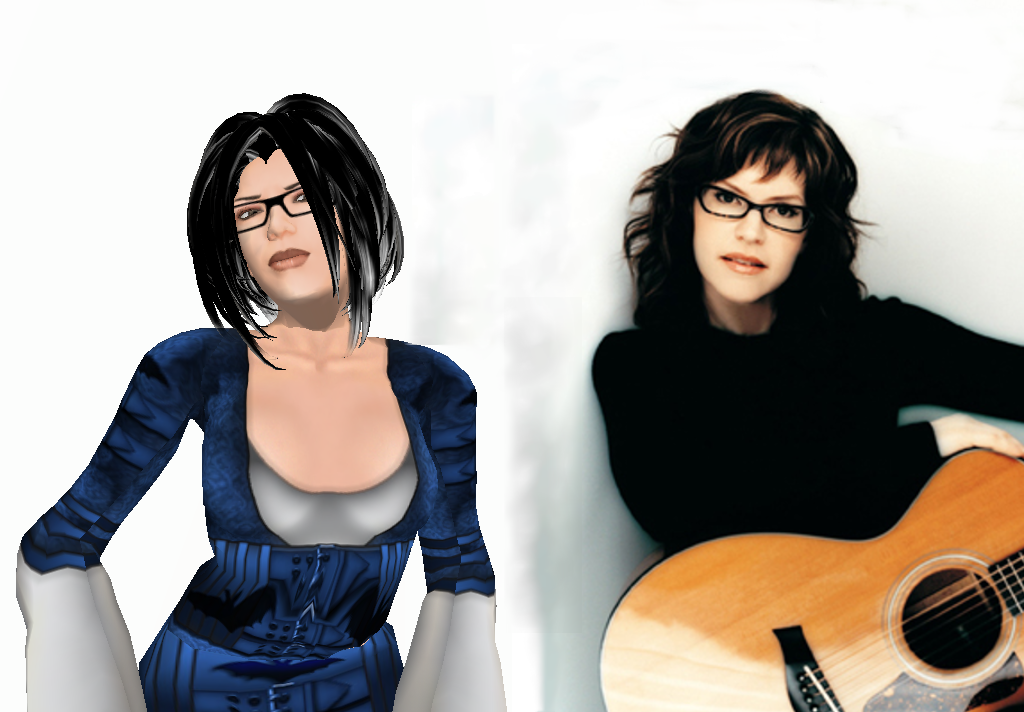
Likenesses

It's been mentioned once before, but Sinestra Sterling really drove home this likeness with Lisa Loeb. (It's the 21st century. You know to click for a larger image, right?)

Monday, July 03, 2006

Dreamscapes

Sometimes I've dreamed dreams that consistently take place in places that don't quite exist. A melange of the real, and the plauisbly different. Events in a house that isn't there in the waking world, but recurs time after time. A railway station that exists where a park normally resides. A persistent backdrop for dream after dream over years.

And as I sip my coffee and wait for the sun to come up, I wonder...what if I could make this place? This house that I keep seeing. This neighborhood. That street. See them and walk them in the waking (if virtual) world.

What would I learn about myself, perhaps? About the way I connect ideas, thoughts, images, meaning. Maybe too, I would discover all sorts of holes in what appears, in my dreams, to be a whole cloth.

Would it all gain or lose something in the translation? And the translation itself would be a brobdignagian task. Converting the imagery of the mind into anything external is quite the feat in and of itself. Ask any artist.

Sunday, July 02, 2006

Reading the numbers II

Okay, let's have another run up at the population figures, now that we have a something to compare it to.

The economic stats show the population logged in over the last 60 days is 154,440. A whopping 99,985 of those are new accounts.

That gives us a repeat business figure of 54,455. Only 2,152 up from the figures I calculated last time.

Now we've got a reference point to work from, we can take a stab at figuring a retention rate. 99,985 into 2,152 yields 2.15% estimated new resident retention. About 1 in 50.

Of course that's based on only two data points less than a month apart. Additionally there's a few days slop in my new account numbers, until I get my data reprocessed for analysis. However the number feels relatively solid.

That reinforces the notion that the increased concurrency is the result of more existing residents making more time for SL, rather than the increased concurrency being a product of new residents.